Acanthocephala
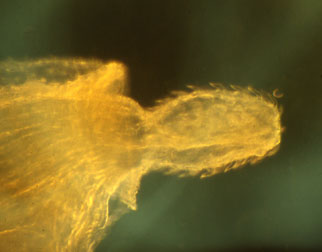
Polymorphus sp. showing the spiny proboscis that gives acanthocephalans their name. Image source: University of Edinburgh.
Acanthocephala, or the spiny-headed worms, is a phylum of worms parasitic (see parasite) on vertebrates such as fish and birds. Named for the retractable proboscis, which bears tiny hooks that anchor them to the intestinal walls of their hosts, these worms are so degenerate that most have little more than a reproductive system and a simple brain. They often cause fatal infection.
Acanthocephalans require two hosts to complete their life cycle. The young are parasitic in arthropods and the adults, which are typically 1–2 centimeters (0.4–0.8 inch) long and have an elongated, cylindrical body, are parasitic in vertebrates (especially fish), living in the digestive tract. As in the case of tapeworms, acanthocephalans have no gut and absorb nutrients directly from the host's gut through the tegument. About 1,150 species are known.
The adult worms live in the intestines of the definitive host, where they lay eggs. The eggs are passed out of the host in the feces and hatch into infective larvae in the environment. The larvae are then eaten by intermediate hosts, such as insects, snails, or crustaceans. Inside the intermediate host, the larvae develop into infective cysts that can be ingested by the definitive host when the intermediate host is eaten.
Once inside the definitive host, the infective cysts release the worms, which burrow into the intestinal wall and begin to grow and reproduce. Acanthocephala worms are typically found in the small intestine, where they can cause damage to the intestinal lining and disrupt the absorption of nutrients.
Symptoms of acanthocephala infection may include abdominal pain, nausea, vomiting, diarrhea, and weight loss. In severe cases, the worms can cause blockages in the intestine and lead to malnutrition. Acanthocephala infections can also increase the risk of other infections, as the worms can weaken the immune system.
Acanthocephala infections are most commonly found in developing countries, where poor sanitation and a lack of clean water can facilitate the transmission of the worms. The infections are also more common in areas where raw or undercooked meat is consumed, as the worms can be transmitted through the consumption of infected intermediate hosts.
Treatment for acanthocephala infections typically involves the use of medications to kill the worms. The most commonly used medications for acanthocephala infections are albendazole and mebendazole, both of which are effective at killing the worms and eliminating the infection. In severe cases, surgery may be necessary to remove the worms or to correct any damage caused by the infection.
Prevention of acanthocephala infections involves good hygiene practices, such as washing hands thoroughly with soap and water, avoiding undercooked or raw meat, and practicing proper food preparation techniques. Ensuring access to clean water and proper sanitation can also help to reduce the risk of acanthocephala infections.