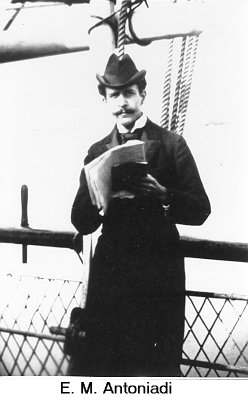
Antoniadi, Eugène Michael (1870–1944)
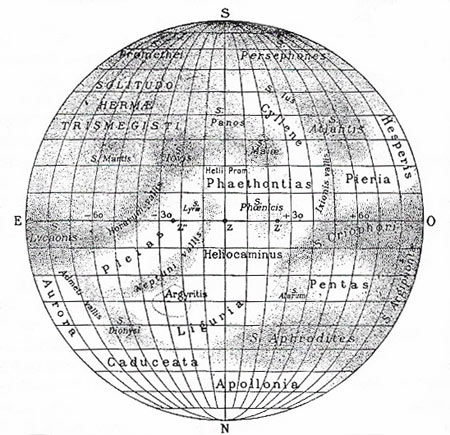
This map of Mercury was drawn between 1924 and 1933 by Antoniadi, who named the main features. There is very little poor correlation between the dark areas shown and images returned by space probes that have flown by or orbited Mercury.
Eugène Antoniadi was a Turkish-born astronomer, of Greek descent, who spent most of his life in France and became a leading observer and map-maker of the planet Mars and decisive critic of the canal hypothesis of Mars. Earlier in his career, Antoniadi worked at Flammarion's observatory at Juvisy and claimed to have seen martian canals.
In 1898 he put forward a geological explanation for some of the markings while others he argued were the boundaries of shaded areas. As late as 1903, he maintained the "incontestable reality" of the canal phenomenon. So great had become his reputation as an observer that by the 1909 opposition of Mars he was given access to the largest telescope in Europe, the 83-centimeter (33-inch) refractor at the Meudon Observatory. With this instrument, he claimed he was able to resolve the canals into streaks or borders of darker regions and concluded: "The geometrical canal network is an optical illusion; and in its place the great refractor shows myriads of marbled and checkered objective fields ..." Quickly, observers in the United States, including George Hale, confirmed Antoniadi's opinion and worldwide belief in the canal hypothesis went into rapid decline. In his magnum opus, La Planète Mars (1930),1 he presented a state-of-the-art summary of martian topography and helped set the scene for the modern investigation of the planet.
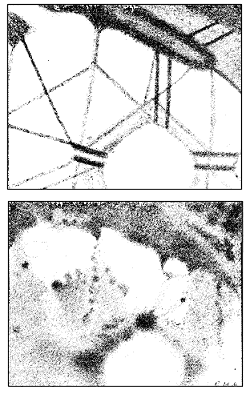 |
| Two drawings of the same part of the Elysium region
of Mars. The upper one is by Schiaparelli based on his observations
in 1877 and 1890. The lower one is by Antoniadi and based on his observations
of 1909, 1911, 1924 and 1926, shows no signs of the canals. (Photo
credit: Eugène Antoniadi, La Planète Mars).
|
Antoniadi was also a regular observer of the inner planets, Mercury and Venus, and his La Planète Mercure et la Rotation des Satellites (Paris, 1934) was the only work on this subject for two decades. In it, he published the most detailed pre-Space Age map of Mercury based on the assumption, first made by Schiaparelli, that the planet always keeps the same face toward the Sun – an assumption now known to be false. Antoniadi claimed to have seen local obscurations which he thought were due to material suspended in a thin Mercurian atmosphere.2
References
1. Antoniadi, E. M. La Planète Mars: étude basée sur les resultats obtenus avec la grande lunette de l'observatoire de Meudon et expose analytique de l'ensemble des travaux éxécutés sur cet astre depuis 1659. Paris: Libraire scientifique Hermann et cie (1930) 1st English language ed., The Planet Mars, trans. by Patrick Moore. Keith Reid Ltd (1975).
2. Antoniadi, E. M. La Planète Mercure et la rotation des satellites; étude basée sur les resultats obtenus avec la grande lunette de l'observatoire de Meudon. Paris: Gauthier-Villars (1934).
Antoniadi scale
The Antoniadi scale is a five-point scale, devised by Antoniadi and used by amateur astronomers to indicate the quality of seeing: I – perfect seeing, without a quiver; II – slight undulations, with moments of calm lasting several seconds; III – moderate seeing, with larger tremors; IV – poor seeing, with constant troublesome undulations; V – very bad seeing, scarcely allowing the making of a rough sketch.