asbestos
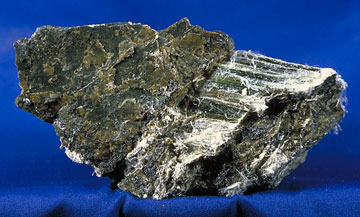
Asbestos in the form of the mineral chrysotile.
Asbestos is any of various fibrous, silicate minerals, chiefly chrysotile and amphibole mineral. Asbestos is a valuable industrial material because it is refractory (i.e., has a very high melting point), alkali- and acid-resistant, and an electrical insulator. It can be spun to make fireproof fabrics for protective clothing and safety curtains, or molded to make tiles, bricks, and automobile brake linings. Asbestos particles may cause pneumoconiosis and lung cancer if inhaled, and for this reason the use of asbestos has been banned in many countries.
Mineral varieties of asbestos
Chrysotile asbestos, the fibrous variety of the mineral serpentine, is by far the most important type of asbestos. It forms in metamorphic rock, that is, rock that has been altered by intense heat and pressure. Another natural form of asbestos, crocidolite, is a dark blue variety of the mineral riebeckite. It, too, occurs in metamorphic rock. Only about 4% of the asbestos consumed is crocidolite. Other, less important asbestos minerals in occasional use are amosite, anthophyllite asbestos, tremolite asbestos, and actinolite asbestos.