Bessemer process
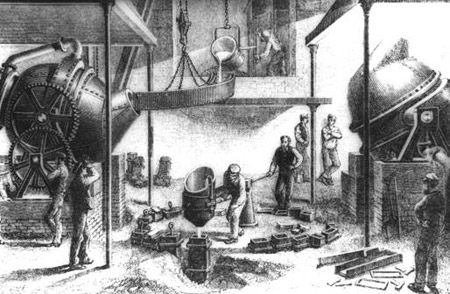
The Bessemer process was the first cheap, large-scale method of making steel from pig iron; it was patented by the British industrialist Henry Bessemer (1813–1898) in 1856, although an American steel-maker, William Kelly (1811–1888), had used a similar process in about 1850. The Bessemer converter is a pivoting, pear-shaped blast furnace lined with refractory bricks. The furnace is tilted, loaded with molten pig iron, then righted. Compressed air blown through the tuyeres burns off most of the carbon and converts silicon and manganese to slag as the temperature rises. If lime is added, an afterblow removes phosphorus.
The Bessemer process was superceded first by the open-hearth process and then the basic oxygen process (also known as the Linz-Donawitz process).