boiling point
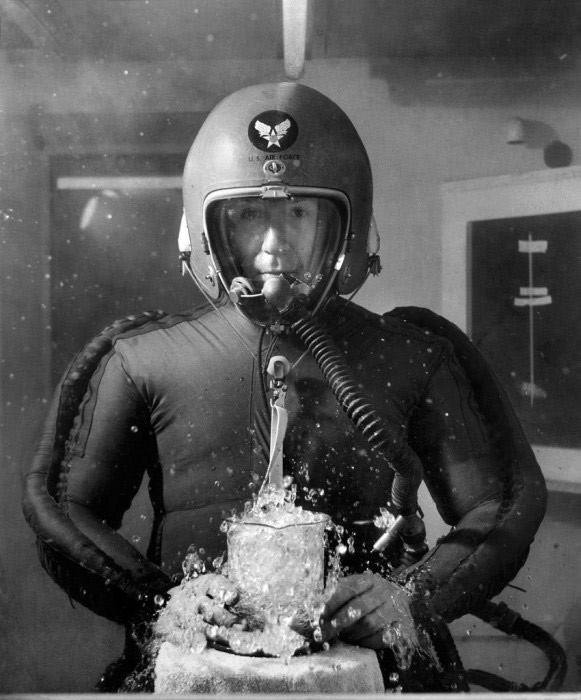
What happens to water at 65,000 feet: it boils at room temperature. Taken in a decompression chamber simulating high altitude. NY Times, 8 February 1954.
The boiling point is the temperature at which the liquid and gas phases of a substance are in equilibrium at a specified pressure; the temperature at which the vapor pressure of a liquid becomes equal to the external pressure. The boiling point increases as the external pressure increases and falls as it decreases. It is usually measured at a standard pressure of one atmosphere (760 millimeters of mercury, 101.325 kilopascals). The boiling point of pure water at standard pressure is 100°C (212°F). Measurement of boiling point is important in chemical analysis and the determination of relative molecular masses.
Compare with melting point.