bubble life
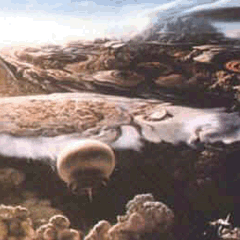
Artist concept of a floating life form in Jupiter's atmosphere.
Some forms of extraterrestrial life, it has been suggested, might be based on bubbles of gas instead of water. Carl Sagan and Edwin E. Salpeter proposed in a 1976 paper,1 that gas-inflated organisms might float in Jupiter's massive atmosphere (see life on Jupiter).
On Earth, water serves as a medium for transporting a huge variety of organic molecules, such as those of sugars and amino acids, with the cell. These molecules are thus able to diffuse and drift freely, enabling enzymes to catch hold of them and facilitate key biochemical reactions, such as the breakdown of sugar molecules to release energy. In the case of extraterrestrial life based on bubbles, however, gas might take the place of water. Simple molecules, such as those of ammonia and methanal (formaldehyde) might move about inside the bubble, while enzymes attached to the inner surface of the bubble latched onto these substances as they drifted past.
Astroenzymology
In a paper called "Astroenzymology – the environmental limits of enzyme activity",2 Roy Daniel of the University of Waikato in New Zealand, describes the remarkable ability of the liver esterase (an enzyme found in pig's liver that splits esters into an acid and an alcohol) to continue functioning even when extremely dehydrated. It will still convert gaseous ethyl butyrate to ethanol, albeit at only about 1% of its normal rate, when 99% of its water content has been removed.
Daniel speculates that on a world where water exists only as a vapor, enzymes might evolve specific sites where condensing water vapor molecules could attach themselves. Such an adaptation would allow the enzymes to work efficiently even in the virtual absence of liquid water.
References
1. Sagan, C., and Salpeter, E. E. "Particles, Environments and Possible
Ecologies in the Jovian Atmosphere," Astrophysical Journal Supplement, 32, 737 (1976).
2. Daniel, Roy M. Astroenyzmology
– the environmental limits of enzyme activity". (pdf)