Cloverleaf Quasar
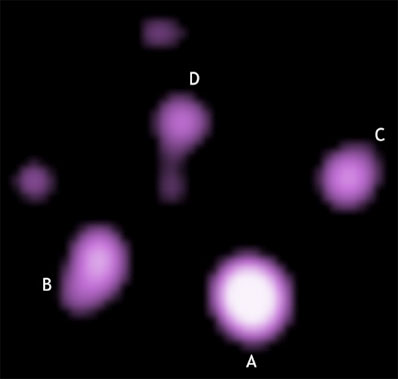
Chandra X-ray view of the Cloverleaf quasar. Credit: NASA/CXC/Penn State/G.Chartas et al
The Cloverleaf Quasar (H1413+117) is a quasar, discovered in 1988 and located about 11 billion light-years away in the constellation Leo, that appears as four different images because of a gravitational lens effect caused by a foreground elliptical galaxy. Molecular gas (notably carbon monoxide, CO) detected in the host galaxy associated with the quasar is the oldest molecular material known and provides us with evidence of large-scale star formation in the early universe.
Data on the Cloverleaf collected by the Chandra X-ray Observatory in 2004 was compared with that gathered by optical telescopes. One of the X-ray components (A) in the Cloverleaf is brighter than the others in both optical and X-ray light but is relatively brighter in X-ray than in optical light. The X-rays from iron atoms were also enhanced relative to X-rays at lower energies. Since the amount of brightening due to gravitational lensing doesn't vary with the wavelength, this means that an additional object has magnified the X-rays. The increased magnification of the X-ray light can be explained by gravitational microlensing, an effect which has been used to search for compact stars and planets in our galaxy. Microlensing occurs when a star or a multiple star system passes in front of light from a background object. If a single star or a multiple star system in one of the foreground galaxies passed in front of the light path for the brightest image, then that image would be selectively magnified. The X-rays would be magnified much more than the visible light, if they came from a smaller region around the central supermassive black hole of the lensing galaxy than did the visible light. The enhancement of the X-rays from iron ions would be due to this same effect. The analysis indicates that the X-rays are coming from a very small region, about the size of the solar system, around the central black hole. The visible light is coming from a region ten or more times larger. The angular size of these regions at a distance of 11 billion-light years is tens of thousands times smaller than the smallest region that can be resolved by the Hubble Space Telescope. This provides a way to test models for the flow of gas around a supermassive black hole.