center of mass
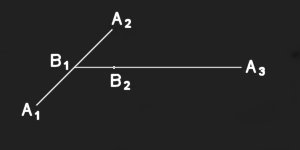
The center of mass is the point at which a system of masses would balance if placed on a pivot. If m1 and m2 are the masses of two particles placed at the points A1 and A2, and if the line A1 A2 is divided at B1, so that m1 A1 B1 = m2 A2 B1, the point B1 is the center of mass of the two particles. If m3 is a third mass at A3, and if B1 A3 is divided at B2, so that (m1 + m2) = m3 (A3 B2), B2 is the center of mass of the three particles. In general, if there are any number of particles, a continuation of the above process will enable us to find their center of mass. Every body may be supposed to be made up of a very large number of particles connected by cohesion. From this it is clear that the center of mass is a definite point for every piece of matter.
In general, the determination of the center of mass requires the use of
integral calculus. In the case of some bodies, such as those which have
a simpler geometric form and are of uniform density, elementary mathematical
methods will generally suffice. Any straight line or plane that divides
a homogeneous body symmetrically must contain its center of mass. This can
be understood because the particles of the body may be arranged in pairs
of equal mass and at equal distance from the line or plane; and, since the
center of mass of each pair lies in the line or plane, the center of mass
of the whole must also lie in the same line or plane. For example, the center
of mass of a uniform thin straight rod is the middle point; that of a uniform
rod bent in the form of a parallelogram,
the point of intersection of its diagonals; that of a lamina, uniform in
thickness and density and in the form of a circle, ellipse, or parallelogram, its center of
figure; that of a homogenous sphere, its
center; that of a parallelepiped,
the intersection of its diagonals; that of a circular cylinder with parallel ends, the middle point of its axis.
An important case is that of a uniformly thin triangular plate. Let ABC be the plate. Bisect AB at P and join CP. Let
the triangle be divided by right lines parallel to AB into an indefinitely
large number of indefinitely narrow strips. The center of mass of each strip
is its middle point. But all the middle points lie on CP. The center
of mass of the whole plate must therefore lie on CP. Again, if BC is bisected at Q, and AQ are joined, the center
of mass of the whole plate must lie in AQ. The center of mass must
therefore be O, the point of intersection of CP and AQ.
It is easily proved by elementary geometry that OP = one-third
of CP. Hence, the center of mass of a triangular plate is obtained
by joining a vertex to the middle point of the opposite side and taking
the point two-thirds of this line measured from the vertex. By a similar
method the center of mass of other plane figures may be obtained.
In the case of a single mass, the center of gravity, for the sake of simplicity of calculations, is the point at which it can be assumed all the mass is concentrated. In a binary star system, the center of mass would lie nearer to the more massive component.