condensation
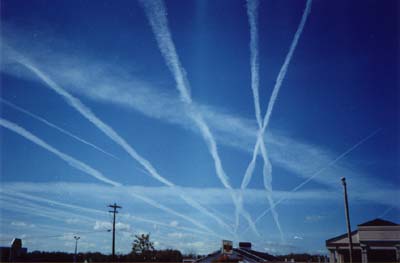
Contrails in the sky caused by condensation of water vapor behind high-flying jets. Credit: NOAA.
Condensation is the formation of a liquid from a gas or vapor, caused by cooling or an increase in pressure. The most familiar example is when water vapor in the air changes into water droplets, forming mist, clouds, rain, or drops on cold surfaces. Warm air can hold more water vapor than cool air; if a body of air is cooled it will reach a temperature, called the dew point where the water vapor it holds is at saturation level. Further decrease in temperature without change in pressure will initiate water condensation. Such condensation is greatly facilitated by the presence of condensation nuclei ("seeds") small particles (e.g., of smoke) about which condensation may begin.
Condensation trails, or contrails, behind high-flying jet aircraft result primarily from water vapor produced by the engines increasing the local condensation (see also cloud chamber). Condensation is important in all processes using steam; and in distillations, where the liquid is collected, and condensed by removal of its latent heat of vaporization, in an apparatus called a condenser.
See also condensation reaction.