Dragon's Egg
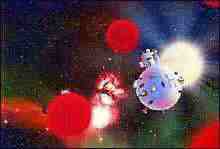
Cover art to Czech edition of Dragon's Egg.
Dragon's Egg is a science fiction novel1 (1980) by Robert L. Forward, based on an idea first suggested by Frank Drake, which describes a thriving community of intelligent beings living on the surface of a neutron star (see neutron star, life on). The extraordinarily high gravity, 67 billion times that on Earth, means that everything, including the life-forms, is made of tightly-packed nuclear matter. The dominant creatures on Dragon's Egg are "cheela", which are similar in intelligence and biological complexity to humans. As Forward explains:2
This implies that they contain the same number of nuclei, so it is not surprising that on Earth their mass is about the same as human beings – 70 kilograms. Their bodies consist of complex molecules of bare nuclei. The cheela are flat, flexible creatures about 50 millimeters in diameter and 0.5 millimeters high. They have a density of about 7 million grams per cubic centimeter, the density of the crust of the neutron star... Cheela cannot breath or talk because the "atmosphere" of Dragon's Egg is only a few micrometers thick (around the "toes" of the cheela). The cheela communicate by strumming the crust with their lower surface, or "tread" to produce directed vibrations in the neutron star's crust.
Forward builds a detailed, scientifically-informed picture of the anatomy, environment, culture, and technology of his hypothetical condensed-matter sentients, and explores the difficulties that the cheelah and our own species would face in making contact. Among these are that the inhabitants of the Dragon's Egg live their lives a million times faster than human beings so that:
Talking to these beings would be difficult. Their biology depends upon the strong nuclear force instead of the electromagnetic force. Nuclear reactions happen much faster than chemical reactions, because the nuclear force is much stronger... With a time difference of a million to one, a second to a human - the time it takes to say "Hello" - would be the equivalent of a week to a star creature. It would hear "He ... " on Sunday and "... lo" on the following Saturday.
Forward took his speculations further in the 1985 sequel, Starquake!.3
References
1. Forward, Robert L. Dragon's Egg. New York: Del Rey (1980).
2. Forward, R. "When You Live Upon a Star," New Scientist, 36
(December 24/31, 1987).
3. Forward, Robert L. Starquake! New York: Del Rey (1985).