earthquake
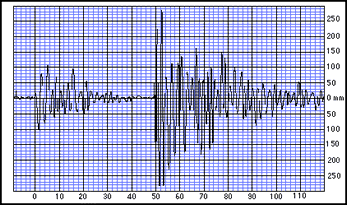
Figure 1. Seismogram recording of an earthquake. Credit: US Geological Survey.
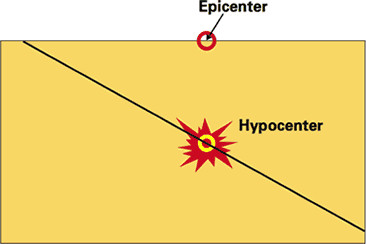
Figure 2. Epicenter and hypocenter, Credit: US Geological Survey.
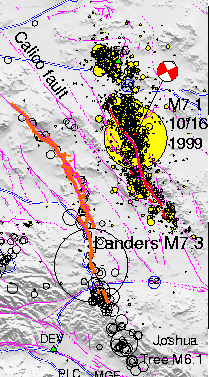
Figure 3. The Landers fault (red lines at left) and the Hector Mine fault and its aftershocks (red lines and circles at right). The Hector Mine earthquake was a magnitude 7.1, and it produced thousands of aftershocks. Image credit: Egill Hauksson, Caltech.
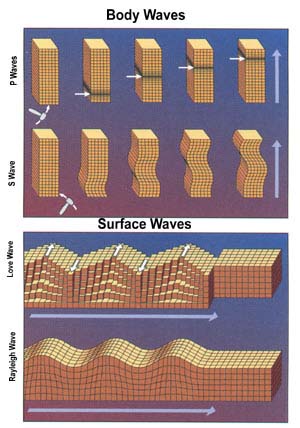
Figure 4. Body waves and surface waves.
An earthquake is a sudden slip on a fault, followed by ground shaking and radiated seismic energy caused by the slip, or by volcanic or magmatic activity, or other sudden stress changes in the Earth (Figure 1). The immediate area where the earthquake takes place is the focus or hypocenter, the point immediately above it on the Earth's surface is the epicenter (Figure 2), and the shock waves emanating from the earthquake are called seismic waves. Depending on the character of the focus, the epicenter may be a small circle or a line.
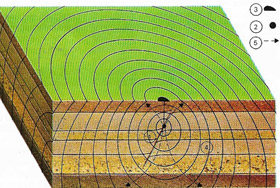 |
| An earthquake takes place when two parts of the Earth's surface move suddenly in relation to each other along a crack called a fault (1). The point from which this movement originates is called the focus (2) and the point on the surface directly above this is called the epicenter (3). Shock waves (4) travel outward from the focus decreasing in intensity the farther they go. These shock waves travel more quickly as they pass through denser material at depth and so the direction of their travel (5) is curved as shown. On the surface the pattern of waves is similar to those of the isoseismal lines connecting points feeling equal shocks. |
Earthquakes occur to relieve a stress that has built up within the crust or mantle of the Earth; fracture results when the stress exceeds the strength of the rock. The reasons for the stress build-up are to be found in the theory of plate tectonics. If a map is drawn of the world's earthquake activity, it can be immediately seen that earthquakes are confined to discrete belts. These belts signify the borders of contiguous plates; shallow earthquakes being generally associated with mid-ocean ridges where creation of new material occurs, deep ones with regions where one plate is being forced under another.
Aftershock
An aftershock is an earthquake that follows the largest shock of an earthquake sequence. Aftershocks are smaller than the main shock and within 1–2 fault lengths distance from the main shock fault. Aftershocks can continue over a period of weeks, months, or years. In general, the larger the main shock, the larger and more numerous the aftershocks, and the longer they will continue.
Seismic wave
A seismic wave is an elastic wave generated by an earthquake or other impulse such an explosion. The velocity (speed and direction) of seismic waves varies according to the material (type of rock, molten core, or oil) through which they pass.
Seismic waves may travel either along or near the Earth's surface, when they are known as surface waves, (Rayleigh and Love waves) or through the Earth's interior, when they are known as body waves (Figure 4). Body waves, transmitted by the solid Earth, consist of either primary (P) and secondary (S). P waves are compression waves and vibrate in the direction that they are advancing; S waves are shear waves and vibrate at right-angles to the direction in which they are advancing. Only P waves are transmitted through fluid (liquid or gas) zones.
Body waves travel from the hypocenter. Surface waves travel from the epicenter and also of two types. Love waves are at right angles to the direction or propagation; Rayleigh waves have a more complicated, backward elliptical movement in the direction of propagation.
Strength of earthquakes
The experienced intensity of an earthquake depends mainly on the distance from the source. Local intensities are gauged in terms of the Mercalli Intensity Scale, which runs from I (detectable only by seismograph) through to XII ("Catastrophic"). Comparison of intensities in different areas enables the source of an earthquake to be located. The actual magnitude of the event is gauged according to the Richter scale.
Earthquake hazard is anything associated with an earthquake that may affect the normal activities of people. This includes surface faulting, ground shaking, landslides, liquefaction, tectonic deformation, tsunamis, and seiches.
Earthquake risk is the probable building damage, and number of people that are expected to be hurt or killed if a likely earthquake on a particular fault occurs. Earthquake risk and earthquake hazard are occasionally incorrectly used interchangeably.
Recent major earthquakes
· Chile, 27 February 2010: 8.8 magnitude quake
· Haiti, 12 January 2010: About 230,000 people die after shallow 7.0
magnitude quake
· Sumatra, Indonesia, 26 December 2004: 9.2 magnitude. Triggers Asian
tsunami that kills nearly 250,000 people
· Alaska ,28 March 28, 1964: 9.2 magnitude; 128 people killed.
Anchorage badly damaged
· Chile, south of Concepcion, 22 May 1960: 9.5 magnitude. About
1,655 deaths. Tsunami hits Hawaii and Japan
· Kamchatka, NE Russia, 4 November 1952: 9.0 magnitude