Geiger-Müller counter
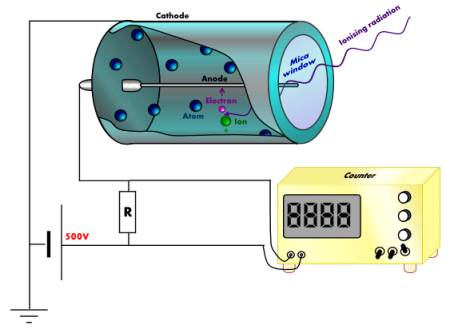
Geiger-Müller counter. Credit: Wikipedia, drawn by Theresa Knott.
A Geiger-Müller counter, also called a Geiger counter or Geiger tube, is an instrument for detecting the presence of and measuring ionizing radiation such as alpha particles, beta particles, and gamma rays. A Geiger-Müller counter an count individual particles at rates up to about 10,000 per second and is used widely in medicine and in prospecting for radioactive ores.
A fine-wire anode runs along the axis of a metal cylinder which has sealed insulating ends, contains a mixture of argon or neon and methane at low pressure, and acts as the cathode, the potential between them being about 1,000 volts. Particles entering through a thin window cause ionization in the gas; electrons build up around the anode and a momentary drop in the inter-electrode potential occurs which appears as a voltage pulse in an associated counting circuit. The methane quenches the ionization, leaving the counter ready to detect further incoming particles.
The device is named for Hans Geiger who invented it in 1908, and Walther Müller who collaborated with Geiger in developing it further in 1928.