Gemini Project
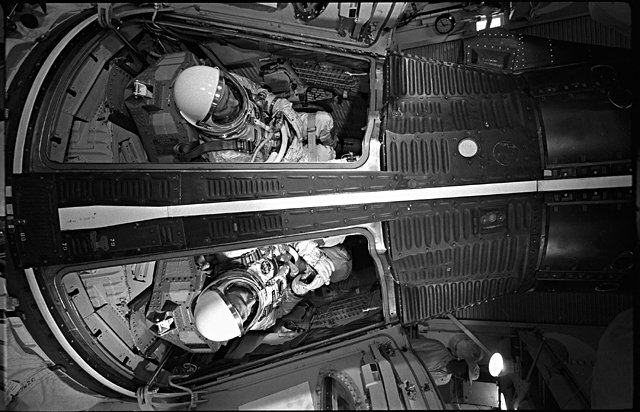
James McDivitt and Ed White inside the Gemini spacecraft for a simulated launch at Cape Canaveral.
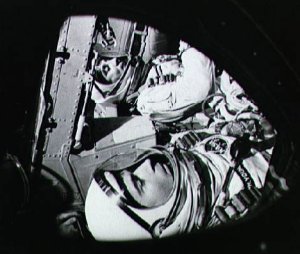
Young, in foreground, with Grissom inside the Gemini 3 capsule.
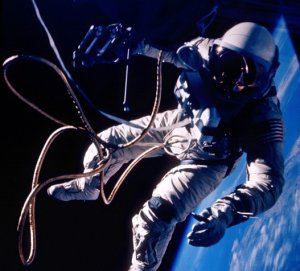
Ed White on the first US spacewalk. Tethered to the Gemini 4 capsule, White can be seen holding a compressed gas "zip gun" for maneuvers in his right hand.
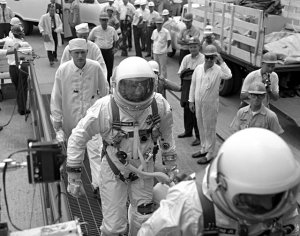
Gemini 5 crew, Pete Conrad and Gordon Cooper on their way to the launch pad.
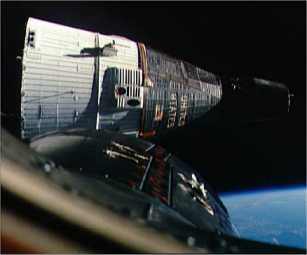
Gemini 6A and 7 rendezvous in orbit.
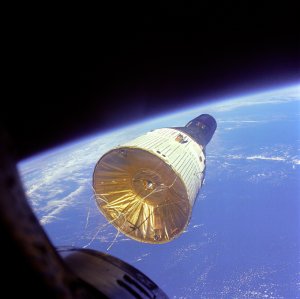
Gemini 6 capsule seen from Gemini 7.
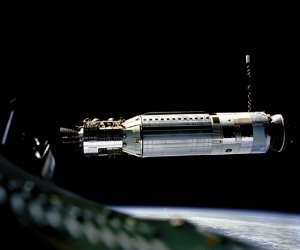
Agena Target Vehicle from Gemini 8.
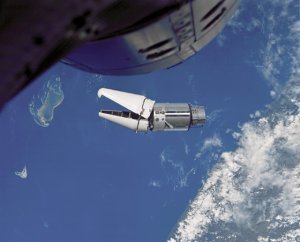
The Augmented Target Docking Adapter (ATDA) as seen from Gemini 9 during one of their three rendezvous in space. The ATDA and Gemini 9 spacecraft are 66.5ft. apart. Failure of the docking adapter protective cover to fully separate on the ATDA prevented the docking of the two spacecraft.
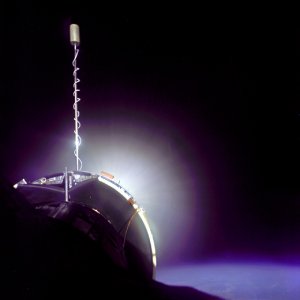
Gemini 10 successfully docked with the Agena Target Vehicle. The Agena display panel is visible as is glow from Agena's primary propulsion system.
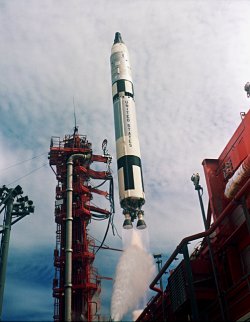
Lift-off of Gemini-Titan 11.
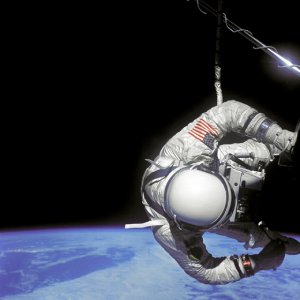
Aldrin performs a spacewalk during the Gemini 12 mission.
The Gemini Project was the second human spaceflight program conducted by the United States. It consisted of a series of two unmanned and ten manned NASA missions launched between April 1964 and November 1966. Gemini, with its two-seater capsule, built on the success of the Mercury Project and paved the way for the Apollo Project. Equipped with the Orbital Attitude Maneuvering System (OAMS) to create a controlled orbital and reentry path, the Gemini craft were the first fully maneuverable American manned spacecraft.
The first two Gemini missions were unmanned. Gemini 1 was to check compatibility between the Gemini spacecraft and the Titan II launch vehicle (see Gemini-Titan II) and no attempt was made to separate the two during their brief flight. Gemini 2 was a suborbital test of the Gemini reentry system. There then followed 10 successful manned missions.
Gemini 3
| Command pilot: Virgil Grissom Pilot: John Young Highlight: first American two-manned spaceflight |
The first manned Gemini and the first American space mission with two astronauts aboard. During the flight, Gemini 3's orbit was varied using thrusters to rehearse techniques needed for upcoming rendezvous and docking missions.
The capsule was unofficially dubbed "Molly Brown" after a survivor of the Titanic and in reference to the fact that Grissom's Mercury capsule sank and was lost during his first spaceflight. Illicit cargo included a corned beef sandwich reportedly from Wolfie's Restaurant in Cocoa Beach, which was bought by Grissom, carried aboard by Young, and partly consumed by Grissom during the flight. Young was authorized to eat specially prepared food, and Grissom was supposed to have gone without. The possibility that weightless crumbs from the sandwich might have compromised safety led NASA managers to clamp down on what future astronauts could take into space.
Although one of the goals of the program was to achieve pinpoint recoveries, Gemini 3 splashed down about 95 kilometers from its primary recovery vessel (a result of Molly Brown having less lift than wind tunnel tests had predicted). Unlike the Mercury capsules, which came down upright, the Gemini capsules were designed to splash down on their sides. In the event, the force of the impact hurled the astronauts against their respective windows, causing the faceplate in Grissom's helmet to crack and that of Young's to be scarred.
Gemini 4
| Command pilot: James McDivitt Pilot: Edward White, II Highlight: first American spacewalk |
Considered the first long-duration American spaceflight, this was also the first mission to be directed from Mission Control at the Johnson Space Center instead of the Mission Control Center at Cape Canaveral. Gemini 4's goals were to evaluate the spacecraft and crew during a lengthy stay in space, rendezvous with the spent Titan II second stage, carry out the first American spacewalk, and continue testing the Orbital Attitude Maneuvering System (OAMS).
The plan to fly in formation with the Titan second stage proved to be a real learning experience in orbital dynamics. To catch something in Earth's atmosphere involves simply moving as quickly as possible in a straight line to the place where the object will be at the right time. When the astronauts tried to fly toward the target, they got farther and farther away. The problem is that adding speed also raises altitude, moving the spacecraft into a higher orbit than its target. This paradoxically causes the faster-moving spacecraft to slow down relative to the target because its orbital speed increases with increasing distance from the center of gravity (Earth's center, in this case). To catch up with an object ahead of you in orbit, NASA learned, you must drop down and then rise up after you catch up, rather than speed up. This was a crucial lesson for future rendezvous maneuvers. But, for Gemini 4, it was learned too late and the rendezvous was called off with half the onboard fuel used up. Gemini 4's tanks were only half the size of later models, and the fuel can to be conserved for essential maneuvering later in the mission.
White also took longer than expected to prepare for his spacewalk because the hatch had jammed. However, just over four hours into the mission, the hatch was opened. White stood upright in his seat, fixed a 16-millimeter camera to the spacecraft to record his historic feat, and prepared to exit. On his way out, he lost a thermal overglove, which he had elected not to wear and which drifted away to become an unintended new satellite. White then propelled himself away using a handheld maneuvering unit and became the first American to walk in space. For the duration of his spacewalk, White remained tied to the spacecraft by a 7.6-meter umbilical line that contained an oxygen supply hose, bioinstrumentation wires, and a support tether. He reported that although the line worked well as a retention device, it was awkward to use and easily got tangled. After 20 minutes, McDivitt called his companion back inside and White remarked, "It's the saddest moment of my life." White again had to struggle with the latch and, during the five minutes he took to deploy it, exceeded the cooling capacity of his spacesuit which led to severe condensation inside the helmet; his heartbeat peaked at 180. Once again, the intended landing point was missed by a wide margin – Gemini 4 splashing down 724 kilometers east of Cape Canaveral and some 80 kilometers off target.
Gemini 5
| Command pilot: L. Gordon Cooper Pilot: Charles Conrad, Jr. Highlight: longest manned American spaceflight to date |
A mission during which a new space endurance record was set and the United States (temporarily) took the lead in total space man-hours. Gemini 5 showed that astronauts could endure weightlessness for roughly the time needed to fly to the Moon and back.
The spacecraft was supposed to meet up with a rendezvous evaluation pod released early in the flight, but the rendezvous had to be canceled because of problems with the Gemini 5 fuel-cell system – the first time such a system had been using for supplying water and electricity in space. Instead the crew performed a simulated rendezvous, worked out by Buzz Aldrin, with a phantom target.
A number of other planned on-orbit maneuvering experiments were also called off because of erratic behavior by the OAMS. These cancellations led to plenty of idle time for the astronauts and Conrad later remarked that he wished he had "brought along a book."
On the same day the capsule returned to Earth, Cooper, 160 kilometers above the Earth, spoke with fellow astronaut M. Scott Carpenter who, at the time, was 200 feet below the Pacific Ocean, in the Sealab II habitat.
Once again, the splashdown was well off the mark, missing the target zone by 143 kilometers – an error blamed on faulty data fed to the spacecraft by ground computers.
Gemini 6A
| Command pilot: Walter Schirra,
Jr. Pilot: Thomas Stafford Highlight: rendezvous with Gemini 7 |
A planned rendezvous between Gemini 6 and an unmanned Gemini Agena Target Vehicle (GATV) had to be scrubbed when the GATV failed to reach orbit. Instead a new mission, called Gemini 6A, was announced in which the capsule would meet up with the manned Gemini 7 spacecraft. The latter was launched on 4 December 1965, on a two-week mission but an attempt to launch Gemini 6A on 12 December had to be called off when the Titan II first stage automatically shut down one second after ignition. The shutdown was caused by an electrical umbilical prematurely separating. But it was later found that, because of a dust cap left accidentally in place on an engine component, the first stage thrust was, in any case, in the process of decaying. Without the automatic shutdown caused by the umbilical disconnect, the first stage decay might have led to a catastrophic explosion. Schirra had the option of manually ejecting from the capsule via rocket-powered ejection seats (unlike the Mercury and Apollo launch vehicles, Gemini was not equipped with an escape tower), but decided against this and the astronauts safely left the vehicle after about 90 minutes.
Launch eventually took place three days later. A successful rendezvous was completed just under six hours into the flight, the two spacecraft approaching to within about 37 m. Station-keeping maneuvers continued for over three orbits at separation distances of 30–90 meters – close enough for the crews to see each other. Gemini 6A then maneuvered away and the two spacecraft flew in formation about 48 kilometers apart until Gemini 6A began its reentry sequence. Achieving the most precise Gemini recovery to date, the capsule splashed down just 11 kilometers from its primary target point.
Gemini 7
| Command pilot: Frank Borman Pilot: James Lovell, Jr. Highlight: long-duration mission |
The longest Gemini flight; it rivaled even the Space Shuttle in terms of length of stay in orbit for a single vehicle. Shortly after the capsule separated from the Titan II second stage, the crew moved to within about 18 meters of the spent booster and performed about 15 min of station-keeping. The crew then prepared to carry out 20 experiments and five OAMS tests, including an OAMS burn to place Gemini 7 on the right orbit to serve as a rendezvous target for Gemini 6A. Rendezvous between the two manned spacecraft – the first in spaceflight history – took place on the eleventh day of the mission. (Vostok 3 and 4 passed within 6 kilometers of each other in August 1962 but this was not considered a rendezvous because the capsules were not maneuverable.)
Gemini 7 was also the first American spaceflight during which for much of the time the crew left off their pressurized suits. A new spacesuit was introduced for the mission which, although lighter, proved uncomfortable when worn for long periods. Both astronauts brought along books to read, heeding the advice given by Conrad after Gemini 5. Gemini 7 splashed down just 10 kilometers off target, barely beating the record set by Gemini 6A two days earlier.
Gemini 8
| Command pilot: Neil Armstrong Pilot: David Scott Highlights: docking and emergency landing |
The first successful dual launch and docking with a GATV and the world's first on-orbit docking of two spacecraft. Originally scheduled for three days, the mission was aborted after just one.
During the first six hours of the flight, Gemini 8 maneuvered nine times in order to approach the GATV to within about 45 meters. Docking was achieved just over half an hour later; however, a dangerous malfunction soon followed. Just 27 minutes after docking, a short-circuit in the OAMS caused fuel to be lost through one of the capsule's thrusters. Although the astronauts didn't know exactly what was wrong, the effects were almost immediate. Seconds after the mishap, the mated spacecraft began to spin rapidly. Armstrong was able temporarily to correct the problem by sequentially firing the OAMS thrusters, but the spin kept restarting. Mission controllers and the astronauts assumed the problem was with the GATV, so promptly undocked; however, Gemini 8 began to spin faster – up to one revolution per second. The motion so disoriented the astronauts that they had trouble seeing clearly, and communications with the ground became difficult. Armstrong had to act fast before the astronauts lost consciousness. In a rule-breaking move, he manually disabled the OAMS thrusters, activated the Reentry Control System (RCS) thrusters, and managed to steady the spacecraft's motion. But the process used up so much RCS fuel that the rest of the mission had to be called off.
Gemini 8 returned safely to Earth in a designated emergency area of the Pacific – the only Pacific splashdown of the Gemini program – just 5 kilometers from the recovery ship. Not surprisingly, Armstrong and Scott suffered severe space sickness, which continued after the capsule was recovered.
Gemini 9A
| Command pilot: Thomas Stafford Pilot: Eugene Cernan Highlights: rendezvous and 2-hour EVA |
The prime crew for Gemini 9 had been Elliot M. See as command pilot and Charles A. Bassett as pilot. However, these two astronauts were killed in a T-38 jet training crash at St. Louis Municipal Airport, Missouri on 28 February 1966. Ironically, their plane bounced off the building in which the Gemini 9 spacecraft was being prepared for flight, smashed into a parking lot, and exploded – minutes before Stafford and Cernan touched down at the same airport.
The original mission was to have involved docking with a GATV. However, when the GATV failed to reach orbit NASA decided to launch an Augmented Target Docking Adapter (ATDA) instead, and rename the mission Gemini 9A. The ATDA was launched on 1 June 1966. Two days later Gemini 9A took off and rendezvoused with the ATDA on the third orbit – only to find that a docking would be impossible. The ATDA's shroud had only partially separated, prompting Stafford and Cernan to label their target "the Angry Alligator."
Although docking was out of the question, the crew successfully completed several test maneuvers, including a rendezvous using optical equipment only and a rendezvous from above the ATDA rather than below as on previous flights. These were important steps in flight-testing proposed docking techniques between the Apollo Command and Lunar Modules.
Later in the mission, Cernan went on a spacewalk – the second of the American space program-exiting the spacecraft manually without the help from a maneuvering unit. He spent 1 hour 46 minutes outside the capsule, tethered by an umbilical line which he disparagingly nicknamed "the snake." During the walk, Cernan was supposed to have carried out the first test of a thruster-powered Astronaut Maneuvering Unit (AMU), stored in the Gemini 9A adapter section and accessible only from outside the spacecraft. The AMU, which had a self-contained life support unit, would have allowed Cernan to propel himself up to 45 meters away from the spacecraft and back. However, he had to work so hard to prepare and don the AMU that his helmet's faceplate fogged up and, worse, as he struggled with the AMU, Cernan accidentally snagged an antenna on the capsule which caused several tears in the outer layer of his spacesuit. The Sun beating down on these rips caused hot spots and, together with the other problems, led to the spacewalk being cut short and the AMU test abandoned. Gemini 9A easily took the record for the most accurate splash-down of the Gemini program – just 1.5 kilometers from its prime target.
Gemini 10
| Command pilot: John Young Pilot: Michael Collins Highlights: docking, EVA, and two rendezvous |
The second successful dual launch and docking with a GATV. The latter was launched about 100 minutes ahead of Gemini 10. Six hours later the two vehicles rendezvoused and docked; however, these maneuvers used up more OAMS fuel than expected and forced a revision of the flight plan.
Several orbital and docking training maneuvers were canceled, and Gemini 10 remaining docked to the GATV for about 39 hr – longer than originally scheduled. During this time, two milestones were passed. At a mission elapsed time of 23 hours 24 minutes the hatch was opened and Collins stood up in his seat with his upper body extending outside – the first "standup spacewalk" in American space history. Collins was able to photograph stars in ultraviolet light, only possible outside Earth's atmosphere, and took 22 shots of the southern Milky Way using a 70-millimeter camera. Also while the two spacecraft were mated, a series of firings of the GATV thrusters boosted the orbit of the vehicles to a height of 765 kilometers – a record for manned altitude (broken though on the next Gemini flight). The thrusters were then fired in a series of six maneuvers to place the mated spacecraft on a path to intercept the GATV used during the Gemini 8 mission.
Gemini 10 undocked from its own GATV and, about three hours later, rendezvoused, but did not dock, with the Gemini 8 target. This was accomplished solely through visual location because the Gemini 8 GATV could no longer had power to run its radar-locating devices. Two days into the mission, Collins went on a second spacewalk, this time tethered to the spacecraft by a life-support umbilical. Using his Personal Propulsion Unit, he jetted himself toward the Gemini 8 GATV, just three meters away, and removed two experiment packages, including a micrometeorite impact detector. While retrieving these packages, he accidentally set the GATV gyrating slightly, causing problems for Young as he attempted to keep the two spacecraft close together. Using the Gemini 10 thrusters for this purpose caused the fuel to run low and the spacewalk was cut short. During the spacewalk, Collins also let go of his camera which drifted off into space to become another unplanned Earth satellite.
Gemini 11
| Command pilot: Charles Conrad, Jr. Pilot: Richard Gordon Highlights: docking, EVA, tether |
A mission during which rendezvous and docking was achieved with a previously launched GATV in less than one orbit – a key goal because this procedure might become necessary during the upcoming Apollo program. Other highlights included two spacewalks by Gordon, the setting of a new world space altitude record of 1,368 kilometers, and the completion of the first fully automated reentry.
One day into the mission, Gordon went on his first spacewalk, remaining tied to Gemini 11 by an umbilical while attempting to attach a 15-meter rope tether from the GATV to a docking bar on Gemini 11. Although the spacewalk had been scheduled to last 105 minutes, Gordon grew tired while struggling to attach the tether, his helmet fogged up, and consequently he went back inside after just 21 minutes.
At a mission elapsed time of 40 hours 30 minutes the GATV multiple-start engine thrusters were fired to raise the orbit of the mated spacecraft to a maximum altitude of 1,372 kilometers for two orbits, setting a manned altitude record that was not broken until Apollo 8 headed for the Moon. The two high-altitude orbits were completed in 3 hours 23 minutes after which time the GATV thrusters were fired to return the mated spacecraft to their normal orbital altitude.
At a mission elapsed time of 46 hours 7 minutes the hatch was opened for Gordon to begin a standup spacewalk, during which he took of photos and then managed to fall asleep! After the hatch was closed, Gemini 11 was undocked from the GATV and maneuvered to allow it and the tethered GATV to slowly rotate around one another. Although movement of the tethered spacecraft was erratic at first, the motion stabilized after about 20 minutes. Then rotation rate was increased, and again the motion stabilized. It was a challenge for the astronauts to keep the rope tether tight between the spacecraft – it remained stiff, but moved somewhat like a jump-rope as the spacecraft orbited one another. This motion between the spacecraft caused artificial gravity to be created in space for the first time – even though it was only 0.0015 that on Earth. Gemini 11's return to Earth marked the first fully automatic splashdown of the American space program. After initial retrorocket firing, computers made all of the necessary adjustments to bring the capsule down about 5 kilometers from its target point.
Gemini 12
| Command pilot: James Lovell, Jr. Pilot: Edwin Aldrin, Jr. Highlights: docking, 3 EVAs, tether |
The final Gemini mission, during which the crew made the first observation of a solar eclipse from space. After Gemini 12 had docked with its GATV, Aldrin carried out the first of three spacewalks, attaching a 30-meter rope from the GATV to a docking bar on the capsule – a tether twice as long as that used on Gemini 11. To combat some of the problems of fatigue experienced on previous spacewalks, a number of astronaut restraints had been fitted to Gemini 12's exterior. These helped Aldrin work at a more methodical, relaxed pace. His spacewalk was also the first to have been rehearsed underwater in NASA's Neutral Buoyancy Tank. Gemini 12 splashed down less than 5 km from its primary recovery target area.
Gemini Agena Target Vehicle (GATV)
A modified Agena stage launched by an Atlas, which served as a target for rendezvous and docking experiments during the Gemini program. The GATV was an Agena D with a Target Docking Adapter (TDA) on the front. At the start of the Gemini 9 mission, the GATV launch failed and the vehicle fell into the ocean. It was replaced by a backup called the Augmented Target Docking Adapter (ATDA) which was not a modified Agena but simply a TDA with a cylindrical back end to mate it directly to the Atlas. Unfortunately, the ATDA's shroud failed to separate properly leaving it in "Angry Alligator" mode and unable to support the docking.
| Gemini missions | |||||
|---|---|---|---|---|---|
| mission | launch | recovery | duration | orbits | crew |
| Gemini 1 | Apr 8, 1964 | - | - | - | unmanned |
| Gemini 2 | Jan 19, 1965 | - | - | - | unmanned |
| Gemini 3 | Mar 23, 1965 | Mar 23, 1965 | 4 h 53 m | 3 | Grissom, Young |
| Gemini 4 | Jun 3, 1965 | Jun 7, 1965 | 4 d 2 h | 62 | McDivitt, White |
| Gemini 5 | Aug 21, 1965 | Aug 29, 1965 | 8 d | 120 | Conrad, Cooper |
| Gemini 7 | Dec 4, 1965 | Dec 18, 1965 | 13 d 19 h | 206 | Borman, Lovell |
| Gemini 6A | Dec 15, 1965 | Dec 16, 1965 | 1 d 1 h 52 m | 16 | Schirra, Stafford |
| Gemini 8 | Mar 16, 1966 | Mar 16, 1966 | 10 h 41 m | 7 | Armstrong, Scott |
| Gemini 9A | Jun 3, 1966 | Jun 6, 1966 | 3 d 0 h 21 m | 44 | Cernan, Stafford |
| Gemini 10 | Jul 18, 1966 | Jul 21, 1966 | 2 d 22 h 46 m | 43 | Collins, Young |
| Gemini 11 | Sep 12, 1966 | Sep 15, 1966 | 2 d 23 h 17 m | 44 | Conrad, Gordon |
| Gemini 12 | Nov 11, 1966 | Nov 15, 1966 | 3 d 23 h | 59 | Aldrin, Lovell |