Gusev Crater
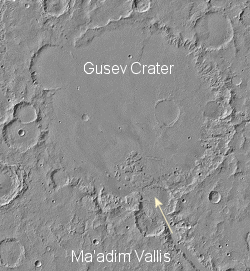
Mars Global Surveyor image of Gusev Crater. The arrow indicates the direction of possible water flow into the crater.
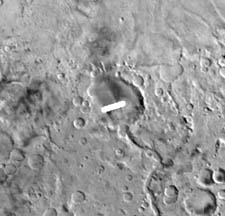
Gusev Crater and surrounding region. The white mark indicates the landing ellipse for the Spirit rover.
Gusev Crater is a 144-kilometer-wide (90-mile) crater, located just south of the equator of Mars, that was the landing site for Spirit, one of the Mars Exploration Rovers. Gusev Crater appears to have been formed by the impact of an asteroid some three to four billion years ago. A channel system, known as Ma'adim Vallis, which probably carried liquid water, or water and ice, drains into the crater, implying that the structure almost certainly once contained a lake. Inside the crater, researchers expect to find sediments, which may be nearly 3,000 feet thick, that have subsequently been overlaid by dust and sand. The Spirit rover will be able to grind away the surface cover on rocks and analyze minerals inside and it will be able to view its surroundings with unprecedented detail and precision. One clear sign of past water will be in the rocks. For example, if Gusev did indeed once hold a giant lake (more than 10 times the size of the famous Crater Lake in the United States) certain key minerals are likely to be found in its rocks.
Spirit might find evaporites – minerals formed as water dries up. Salt or gypsum are familiar ones here on Earth. Salt's component parts – sodium and chloride – are separated, dissolved in sea water, but as the water dries up, the sodium and chloride join together to form the mineral halite. On Mars, Spirit might find evaporites like gypsum, or calcium magnesium sulfate. It might also find minerals involving carbonates (e.g., calcium carbonate). These are sometimes, although not always, produced by or from living organisms. But they are almost always a sign of water when found on Earth. Another sign will be in the way the sediments are organized. For example, if the sediments were blown in by winds, the layers may be more erratic, to reflect the changing directions of airflow (as in fossil dunes here on Earth). If they were deposited by water, they are more likely to be layered evenly, one on top of the other in rhythmic stacks. The most exciting result Spirit might find is that liquid water existed at the surface of this site for a long time because persistent standing bodies of water are possible habitats for life.
Within Gusev Crater lie the Columbia Hills.