HD 114762
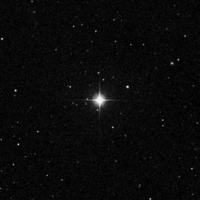
HD 114762 is a Sun-like star in the constellation Coma Berenices, which has an unseen companion first reported in 1989 and described by its discoverers as "probably a brown dwarf, maybe even a giant planet".1 The existence of this companion has since been confirmed, though its nature remains controversial. It lies close to the upper mass limit for exoplanets and the lower mass limit for brown dwarfs. If it proves to be planetary in nature, the high eccentricity of its orbit would place it in the category known as eccentric jovians.
| Host star | |
|---|---|
| distance | 91.3 light-years (28 pc) |
| spectral type | F9 V |
| apparent magnitude | 7.3 |
| position | RA 13h 12m 18.58s; Dec +17° 31' 01.2" |
| other catalog designations | BD+18 2700, SAO 100458 |
| Planet | |
|---|---|
| mass (Jupiter=1) | 11 |
| semimajor axis | 0.34 AU (45 million km, 28 million mi) |
| orbital period | 84.0 days |
| eccentricity | 0.33 |
| discovery | 1999, Latham et al, Harvard-Smithsonian Center |
| method | radial velocity |
Reference
1. Latham, D. W., Stefanik, R. P., Mazeh, T., Mayor, M., and Burki, G. "The Unseen Companion of HD 114762," Nature, 339, 38 (1989).