hand
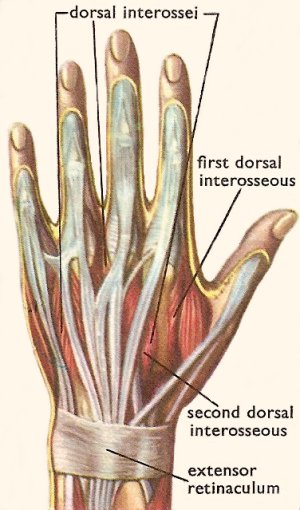
Muscles and tendons of the handx.
The hand is the appendage at the end of the arm of humans and other primates which is used for grasping, gripping, and manipulating objects. Its extraordinary versatility stems largely from the fact that the fingers and thumb can move independently and form an effective grip. The hand is made up of the wrist, palm, and fingers. The bones of the hand are the carpals (wrist bones), metacarpals (in the palm), and phalanges (finger bones).
Movements of the hand are achieved mainly by tendons that attach the muscles of the forearm to the bones of the hand. These tendons are surrounded by sheaths containing synovial fluid, which reduces friction. Other movements are controlled by short muscles in the palm of the hand; some of these muscles make up the prominent areas along the sides of the hand from the bases of the thumb and little fingers to the wrist.
Blood is supplied to the hand by two arteries (the radial artery on the thumb side of the wrist and the ulna artery on the little finger side) and is carried away by veins that are prominent on the back of the hand.
Sensation and movement in the hand are controlled by the radial, ulnar, and median nerves.