International Date Line
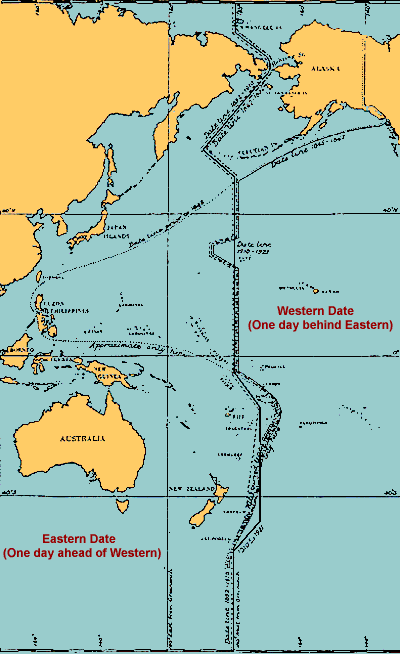
Historical positions of the International Date Line from 'Notes on the History of the Date or Calendar Line,' in The New Zealand Journal of Science and Technology, Vol. XI, pp. 385–388.
The International Date Line is an imaginary line on Earth's surface, with local deviations, along longitude 180° from Greenwich. As Earth rotates, each day first begins and ends on the line. A traveler going east over the line sets her calendar back one day, and going west adds on day.
It isn't possible to assign a time to every longitude on Earth, so that each longitude has a different time but the times at nearby longitudes are always close. This is mathematically equivalent to saying that there's no way to continuously map points on a real number line onto a circle. This explains why an International Date Line is needed. It allows most regions on Earth to have times similar to their neighbors, though, by convention, times are (usually) made in chunks of one hour between adjacent time zones. Then it takes care of the inevitable discontinuity by having it happen all at once, as a jump by one whole day on a longitude that passes mostly through open water in the Pacific. The fact that there doesn't exist any continuous one-to-one function from the circle onto the line follows from the Borsuk-Ulam theorem.
History of the International Date Line
[Text in this section sourced from the US Naval Observatory website]
Over the years, the position of the International Date Line has changed several times. Until 1845, the Philippines were on the eastern side of it (the same side as the United States). It was on the eastern side of the line because it was a Spanish colony and most Europeans arrived there via the Spanish colonies in South America. Indonesia, almost directly to the South of the Philippines, was a Dutch colony and most European arrivals came via the Cape of Good Hope. Thus Indonesia was to the west of the International Date Line.
After the independence of the South American countries, most people traveling to the Philippines also came by way of the Cape of Good Hope, so it was decided to change from the east of the line to the west of the line. Alaska, originally claimed by Russia, was to the west of the International Date Line because most travelers arrived there by way of Siberia. When the United States bought Alaska in 1867 the line was moved to the west of it. The most recent change in the line was in 1995 when Kiribati moved a large segment of it to the east, so that the entire nation would be on the same side of the International Date Line. As with all other changes in the International Date Line, the change was made by a government with local interests. As a result, the line is as far east as 150°, farther east than Honolulu. This did not change where the first sunrise of the new millennium occurred, however. The honor still went to Antarctica.
The position given on most maps is the line drawn by the British Admiralty in 1921.