Lucian of Samosata (c. AD 120–180)
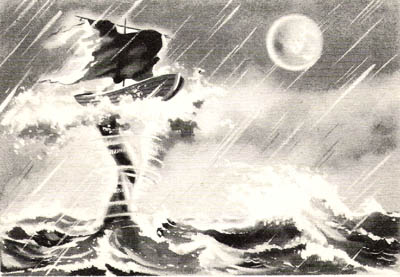
A waterspout lift's Lucian's heroes to the Moon.
Lucian was a Syrian-Greek writer, sophist, and satirist responsible for the first fictional accounts of extraterrestrial life. In his Vera Historia (True History) he provides all the necessary elements of space-travel fiction: a trip through space, a landing on another world, a description of that world, and a return.
Lucian's parents had hoped he might become a sculptor, however he made a fortune by traveling around Asia Minor, Greece, Italy, and other lands giving entertaining speeches, before settling down in Athens to study philosophy. This was a time – the 2nd century AD – when faith in the old gods had all but evaporated, Greek culture and thought was in decay, and the great literature of Greece at its height had given way to shallow novels of adventure or romance.
True History and Icaro-Menippus
All this was grist to Lucian's satirical mill and in his two extraterrestrial stories – precursors of science fiction – he parodies the kind of feeble fantasy that had become popular. The concluding sentence of the preface to his True History reads: "I give my readers warning, therefore, not to believe me." And with that he launches into a tale of a group of adventurers who, while sailing through the Pillars of Hercules (the Strait of Gibraltar), are lifted up by a giant waterspout and deposited on the Moon. There they find themselves embroiled in a full-scale interplanetary war between the king of the Moon and the king of the Sun over colonization rights to Jupiter, involving armies which boast such exotica as stalk-and-mushroom men, acorn-dogs, and cloud-centaurs. The human inhabitants of the Moon are also remarkable:
Amongst them, when a man grows old he does not die, but dissolves into smoke and turns to air [a convenient ploy for disposing of dead aliens also used in more recent science fiction, such as 'The Man Trap' and 'Catspaw' episodes of the original Star Trek series]. They all eat the same food, which is frogs roasted on the ashes from a large fire; of these they have plenty which fly about in the air, they get together over the coals, snuff up the scent of them, and this serves for their victuals. Their drink is air squeezed into a cup, which produces a kind of dew.
Lucian may be off here in Cloudcuckooland (or almost – the trip to the city of Nephelo-coccygia (the cloud cuckoo) actually comes later in the book) but it is interesting that, in his space odyssey, he portrays the Moon and planets as being genuine worlds with unique life-forms of their own. In fact, for many centuries, Lucian's adventure was highly regarded, not as pure fantasy but as speculative fiction, much as we might treat an SF novel by a respected scientist-author today. An example of this is buried in the footnotes of an 1887 edition of Lucian's work (Cassell's National Library series, p. 83). The original translator, one Thomas Franckling, Greek Professor at the University of Cambridge, writing in 1780, had this to say at the point where the Earth is seen suspended in the lunar sky as if it were itself a mere satellite: "Modern astronomers are, I think agreed, that we are to the moon just the same as the moon is to us. Though Lucian's history may be false, therefore, his philosophy, we see, was true." In parentheses after this, the editor of the Cassell edition has inserted the terse comment: "The moon is not habitable, 1887."
In his second space story, Icaro-Menippus, Lucian is again bound for the Moon, this time in the footsteps, or rather the wing-flaps, of his hero who has improved on the ill-fated scheme of Icarus. To his incredulous friend Menippus the hero explains: "I took, you know, a very large eagle, and a vulture also, one of the strongest I could get, and cut off their wings." Lucian, like many who followed him made no distinction between aeronautics and astronautics, assuming that normal air-assisted flight and breathing are possible on voyages between worlds. Then through his hero, he lets rip on the presumptuousness of earlier philosophers to know about the nature of the universe and life beyond the Earth:
... to think that men, who creep upon this Earth, and are not a whit wiser, or can see farther than ourselves ... should tell us the size and form of the stars ... that the sun is a mass of liquid fire, that the moon is inhabited ...
Shah-Nama
Lucian's tale stood alone for centuries. The next surviving account of cosmic travel is found in the 60,000 verse epic poem of Shah-Nama, published by the Persian poet Firdausi in 1010 following forty years of labor. Although it was written eight centuries after Lucian's True History, the Persian epic may contain the record of man's first imaginative venture into space, since it is a retelling of ancient legends.
The hero of the epic is Jamshíd, who reigned for seven hundred years over men, demons, birds, and fairies, and could transport himself on a demon-borne aerial throne into the heavens. The epic alsotells of Kai-Ka'us. a mythical, headstrong king of Persia who was forever embarking on perilous adventures.
One day, Kai-Ka'us was persuaded by a div, or demon, to attempt the conquest of heaven. After questioning wisemen and astrologers, he decided on "crooked and ugly means". He sends men to steal young eagles from heir nests, and has the birds fed on meat until they become "as strong as lions so they could pull a mountain sheep". Then Kai-Ka'us builds a throne, with lances attached from which are hung legs of lamb. Binding four young eagles to the throne, he seats himself on it and is borne into the air as the eagles hurl themselves at the meat. The journey ends disastrously; the eagles become tired, fold their wings, and plunge "headlong from the black clouds, dragging down the king's throne and lances out of the air".