large intestine
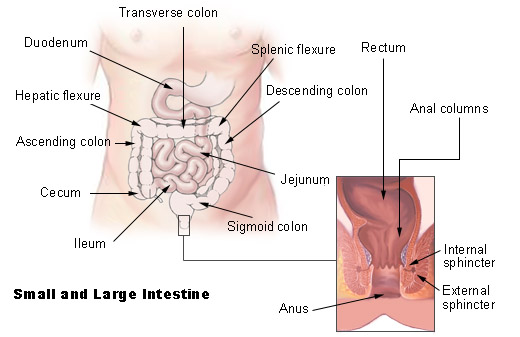
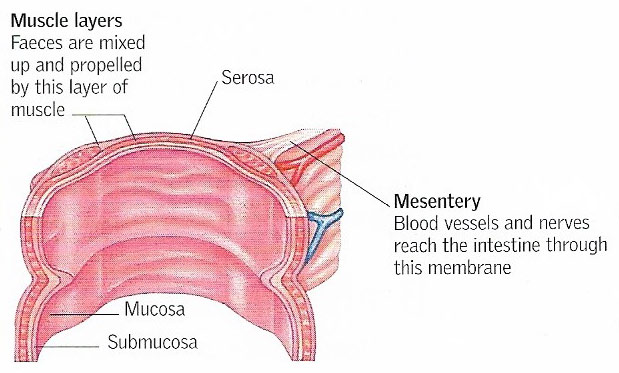
Cross-section of the large intestine.
The large intestine is the part of the gastrointestinal tract (GI tract) that follows, and is larger in diameter than, the small intestine. It begins at the ileocecal junction, where the ileum enters the large intestine, and ends at the anus. The large intestine consists of the cecum, colon, rectum, and anal canal. Its primary role is the excretion of non-absorbed material passed from the small intestine and water absorption.
The wall of the large intestine has the same types of tissue that are found in other parts of the GI tract but there are some distinguishing characteristics. The mucosa has a large number of goblet cells but does not have any villi. The longitudinal muscle layer, although present, is incomplete. The longitudinal muscle is limited to three distinct bands, called teniae coli, that run the entire length of the colon. Contraction of the teniae coli exerts pressure on the wall and creates a series of pouches, called haustra, along the colon. Epiploic appendages, pieces of fat-filled connective tissue, are attached to the outer surface of the colon.
Unlike the small intestine, the large intestine produces no digestive enzymes. Chemical digestion is completed in the small intestine before the chyme reaches the large intestine. Functions of the large intestine include the reabsorption of water and electrolytes and the elimination of feces (water, inorganic salts, epithelial cells, bacteria, and undigested food).
Summary of the large intestine
ascending colon
transverse colon
descending colon
sigmoid colon
rectum
anal canal