lead
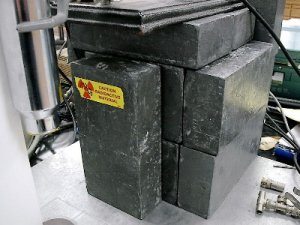
Figure 1. Lead radiation shielding. Credit: L. Chang, Wikipedia
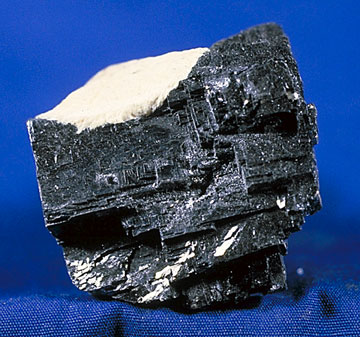
Figure 2. Galena. Credit: Mineral Information Institute.
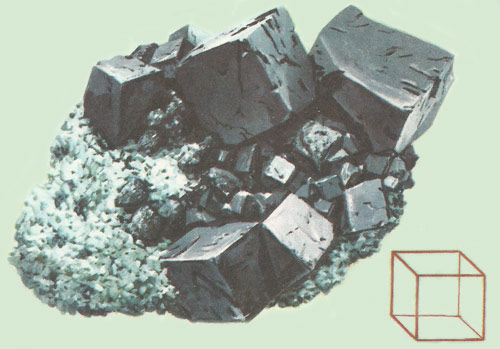
Figure 3. Galena forms cubic crystals.
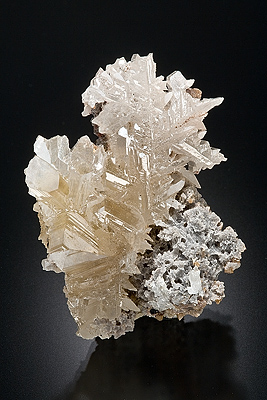
Figure 4. Cerussite.
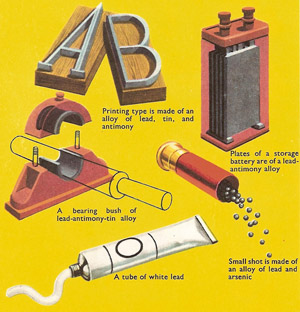
Figure 5. Some traditional uses of lead and its alloys
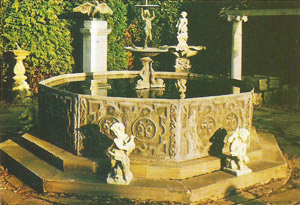
Figure 6. A lead tank made in the 1880s shows no sign of corrosion, demonstrating how well this metal resists attack by ordinary water. Roman architects made extensive use of lead in their elaborate systems of water distribution and public baths. Very soft water attacks lead and, since an accumulation of the metal in the body poisonous, lead pipes are now rarely used to carry drinking water.
Lead (Pb) is a soft, malleable, ductile, dense, metallic element that is bluish-white when freshly cut but tarnishes to gray when exposed to air (Figure 1). Lead occurs in group 14 (old group IVA) and period 6 of the periodic table and has the highest atomic number of any stable element (although bismuth, which has a higher atomic number, is only weakly radioactive and is, for all practical purposes, stable).
Lead has been known since ancient times. Its name is derived from the Anglo-Saxon laedan. The chemical symbol Pb comes from the Latin for "lead", plumbum, which is also the root for "plumbing". Lead was used in pipes, pewter, and paint by the Romans.
| atomic number | 82 |
| relative atomic mass | 207.2 |
| electron configuration | 1s22s22p63s23p64s23d10 4p65s24d105p66s24f145d106p2 |
| ionization energy | 1st: 716 kJ/mol 2nd: 1,450 kJ/mol 3rd: 3,081 kJ/mol 4th: 4,083 kJ/mol |
| oxidation states | +2, +4 |
| covalent radius | 154 pm |
| metallic radius | 175 pm |
| ionic radius | 119 pm (Pb2+), 78 pm (Pb+4) |
| relative density | 11.35 (room temp) |
| melting point | 327.5°C (621.5°F) |
| boiling point | 1,749°C (3,180°F) |
Occurrence and extraction
Lead is extracted chiefly from galena (lead sulfide, PbS) by converting the ore to the oxide by roasting, then smelting with coke. Anglesite (lead sulfate, PbSO4) and cerussite (lead carbonate, PbCO3) are two other lead-based minerals.
Galena
Galena is a gray, brittle mineral (Figures 2 and 3), essentially lead (II) sulfide (PbS), the principal ore of lead. It forms cubic or octahedral crystals, and also occurs as granular masses. Deposits of galena, also called "lead glance," have been worked worldwide for their lead. Galena is found especially in hydrothermal veins and as a replacement for limestone and dolomite rocks. Silver is often found in appreciable amounts in galena. Hardness 2.5–2.7, relative density 7.5.
Cerussite
Cerussite is a white mineral form of lead (II) carbonate (PbCO3), a major ore of lead, found in Mexico, Spain, southwest Africa, Australia, and Colorado, USA (Fig 4). It is formed by weathering (oxidation) of galena. It has prismatic or needle-shaped crystals (orthorhombic) that are usually colorless or white, but may be green or gray with a resinous or vitreous luster. White lead, used as a paint pigment, is a basic lead (II) carbonate (PbCO3 + Pb(OH)2). Hardness: 3–3.5; relative density 6.6.
Anglesite
Anglesite is another ore of lead, consisting of lead sulfate (PbSO4). It is usually found together with cerussite in hydrothermal veins as an alternation product of galena. Its crystals are usually orthorhombic, and can be tabular or prismatic. Anglesite can be colorless, white, or gray. Hardness: 2.5–3, specific gravity 6.4.
Uses of lead
Lead has a low melting-point, is easily cast and makes a number of valuable alloys – with tin for solder, with antimony for electric storage batteries, and with several other metals for alloys for bearings and as sheathing for electric cables. It is also used in making lead crystal, bullets, and radiation shielding (Figures 1 and 5). Like mercury, lead is a potent neurotoxin which can gradually accumulate in soft tissues and bone. For this reason, it is no longer used in making water pipes and tanks (Figure 6), paints, and antiknock compounds (to raise the octane level of gasoline) .
Chemistry of lead
Lead dissolves in dilute nitric acid, but is otherwise resistant to corrosion, because of a protective surface layer of the oxide, sulfate, etc. On the whole, it is chemically unreactive and a poor conductor of electricity.
Compounds of lead
Lead forms two series of salts: the lead (II) compounds are more stable than the lead (IV) compounds.
Lead (II) oxide (PbO) is a yellow, crystalline solid that is insoluble in water. It is made by heating molten lead in air (i.e., oxidizing it), which at low temperature produces the form called massicot and at high temperatures produces litharge. Lead (II) oxide is amphoteric; it dissolves in acids to produce lead (II) salts and in alkalis to give plumbates. It is used in glass, glazes in pottery, paints, and varnishes. It has a melting point of 880°C.
Lead (IV) oxide (PbO2) is a brown amorphous solid that is insoluble in water, but reacts slowly with concentrated acids. It is a powerful oxidizing agent used in matches, fireworks, dyes, and as the anode (positive plate) material in lead-acid accumulators. It decomposes at 290°C.
Trilead tetroxide (Pb3O4), or red lead, is an orange-red powder made by oxidizing litharge; it is used in paints, inks, glazes, and magnets.
Lead sulfide (PbS) is a toxic, black powder. It occurs naturally as the mineral galena. It is insoluble in water, and is used as a semiconductor and in ceramics.
Lead (II) sulfate (PbSO4) is a white, crystalline solid which is virtually insoluble in water. It occurs in nature as the mineral anglesite. With lead (II) hydroxide and water it forms the basic sulfate, which has been employed as a white paint pigment but its toxicity has resulted in a decline in this use.
Lead tetraethyl (Pb[C2H5]4) is a colorless, oily, poisonous liquid made by reacting lead/sodium alloy with ethyl chloride or by the action of lead chloride on a Grignard reagent. It is used in leaded petrol as an anti-knock agent. Relative density 1.65, boiling point 200°C.
Lead ethanoate (Pb[CH3COO]2), formerly known as lead acetate or sugar of lead, is a sweet-tasting but highly poisonous, white crystalline solid which is one of the very few lead salts soluble in water.
Lead poisoning
Lead and several of its compounds are poisonous. Lead poisoning (plumbism) may be acute or chronic. Acute lead poisoning, which may follow inhalation of lead fumes or dust, causes abdominal pain, vomiting, and diarrhea, with paralysis, convulsions, and sometimes encephalitis. In chronic poisoning a characteristic bluish marking of gums ("lead line") is seen and the peripheral nerves are affected; there is also anemia. Treatment is with edetate. The use of lead in paints is now strictly controlled.