M5 (NGC 5904)
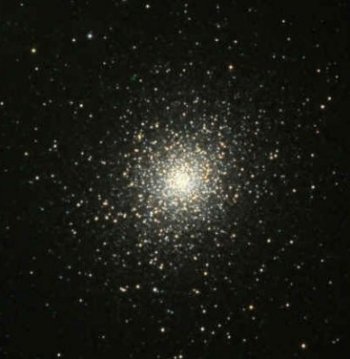
The globular cluster Messier 5.
Image: Sonoita Observatories.
M5 (NGC 5904) is a bright, compact globular cluster in
the constellation Serpens, 8° southwest
of alpha Serpentis. Under very good seeing conditions, M5 can just be glimpsed
with the naked eye. Binoculars reveal it as a fuzzy patch. It was first
seen by Gottfried Kirch and his wife Maria Margarethe in 1702, and found
independently by Charles Messier in 1764.
William Herschel was the first to resolve
it into stars.
M5 shows a marked ellipticity and is one of the oldest globular clusters
in the Milky Way Galaxy with an estimated age of 13 billion years. It may
contain as many as half a million stars.
| visual magnitude | 5.6 |
| angular size | 23' |
| linear diameter | 165 light-years (50 pc) |
| distance | 24,500 light-years (7,500 pc) |
| position | R.A. 15h 18m 34s, Dec. +02° 04' 58" |
| other designations | GCl 34, C 1516+022 |