M series (Japanese rockets)
The M series of Japanese rockets were developed by ISAS (Institute of Space and Astronautical Science) from the earlier and smaller L series ('L' and 'M' are short for 'Lambda' and 'Mu'). In order of debut after the L-4S, they are the M-4S, M-3C, M-3H, M-3S, M-3SII, and M-5.
M-3
 |
| M-3C
|
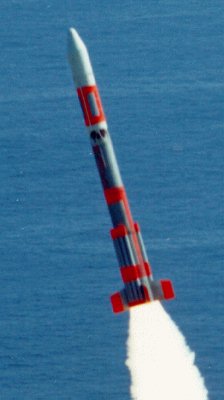
The three-stage M-3C was the second rocket in the M series, after the M-4S. With newly developed second and third stages it improved the accuracy of orbital injection and launched the satellites Tansei-2, Taiyo, and Hakucho. The M-3H was derived by extending the first stage motor casing to increase the propellant capacity and hence the amount of payload that could be carried. It launched Tansei-3, Kyokko, and Jikiken. The third generation M-3S brought further improvements in the accuracy of orbital insertion and launched Tansei-4, Tenma, Hinotori, and Ohzora. A fourth generation began with M-3SII which used the first stage of M-3S, and new upper stages to enhance its payload capability. The M-3SII-1 and -2, with an optional fourth kick stage, sent the first and second Japanese interplanetary probes, Sakigake and Suisei, on their way to an encounter with Halley's Comet. Seven M-3SII launches out of eight have been successful, including those of Sakigake, Suisei, Ginga, Akebono, Hiten, Yohkoh, and ASCA.
M-4
Chronologically, the first member of the M series was the four-stage M-4S rocket. It launched the satellites Tanpei, Shinsei, and Denpa.
M-5
 |
| M-5
|
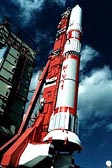
A new launch vehicle to meet demand for increased payload capability and
support interplanetary missions anticipated in the late 1990s and beyond.
It has more than twice the capability of the preceding M-3SII and enables
missions to Mars, Venus, the asteroid belt, and outer Solar System. The
M-5 has the world's largest solid propellant satellite launch system, and
new lightweight materials and structures, flight control and guidance, and
avionics.
| M-4S | M3-C | M-3H | M-3S | M-3SII | M-5 | |
| total length (m) | 23.6 | 20.2 | 23.8 | 23.8 | 27.8 | 30.7 |
| diameter (m) | 1.41 | 1.41 | 1.41 | 1.41 | 1.41 | 2.5 |
| total mass (tons) | 43.6 | 41.6 | 48.7 | 48.7 | 61 | 139 |
| payload to LEO (kg) | 180 | 195 | 300 | 300 | 770 | 1,800 |