Musca
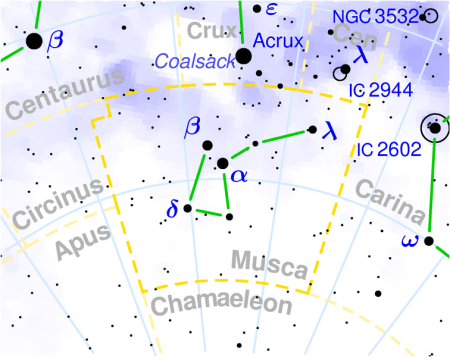
Musca. © 2003 Torsten Bronger.
Musca (abbreviation: Mus), the Fly (originally called Apis, the Bee, by Bayer), is a small constellation of the south circumpolar region, lying south of Crux (in fact, part of the Coalsack extends from Crux into Musca). See below for details of the constellation's brightest stars and interesting deep sky objects.
| Stars brighter than magnitude 4.0 | ||||||
|---|---|---|---|---|---|---|
| star | vis mag | abs mag | spec type | distance (ly) | RA (h m s) | Dec (° ' ") |
| Alpha | 2.69v | -2.17 | B2IV | 306 | 12 37 11 | -69 08 07 |
| Beta | 3.04 | -1.86 | B2.5V | 311 | 12 46 17 | -68 06 29 |
| Delta | 3.61 | 1.38 | K2III | 91 | 13 02 16 | -71 32 56 |
| Lambda | 3.63 | 0.65 | A7III | 128 | 11 45 36 | -66 43 43 |
| Gamma | 3.84 | -1.15 | B5V | 324 | 12 32 28 | -72 07 58 |
| Other objects of interest | ||
|---|---|---|
| name | type of object | notes |
| NGC 5189 | planetary nebula | A highly irregular planetary. Magnitude 10; diameter 2.6'; RA 13h 33.7m, Dec -65° 58.5' |
| NGC 4833 | globular cluster | A bright cluster, close to Delta Mon, well seen in
a small telescope. Magnitude 7.3; diameter 13.5'; RA 13h 00m, Dec -70° 53' |
| NGC 4372 | globular cluster | Close to Gamma Mon and similar to NGC 4833. Magnitude 7.8; diameter 18.6'; RA 12h 25.8m, Dec -72° 40' |
| Constellations |
| Andromeda | Antlia | Apus | Aquarius | Aquila | Ara | Aries | Auriga | Bootes | Caelum | Camelopardalis | Cancer | Canes Venatici | Canis Major | Canis Minor | Capricornus | Carina | Cassiopeia | Centaurus | Cepheus | Cetus | Chamaeleon | Circinus | Columba | Coma Berenices | Corona Austrina | Corona Borealis | Corvus | Crater | Crux | Cygnus | Delphinus | Dorado | Draco | Equuleus | Eridanus | Fornax | Gemini | Grus | Hercules | Horologium | Hydra | Hydrus | Indus | Lacerta | Leo | Leo Minor | Lepus | Libra | Lupus | Lynx | Lyra | Mensa | Microscopium | Monoceros | Musca | Norma | Octans | Ophiuchus | Orion | Pavo | Pegasus | Perseus | Phoenix | Pictor | Pisces | Piscis Austrinus | Puppis | Pyxis | Reticulum | Sagitta | Sagittarius | Scorpius | Sculptor | Scutum | Serpens | Sextans | Taurus | Telescopium | Triangulum | Triangulum Australe | Tucana | Ursa Major | Ursa Minor | Vela | Virgo | Volans | Vulpecula |