mammal
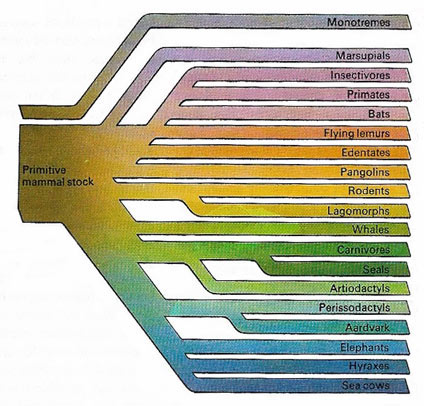
Fig 1. The mammals, which all developed from a shrew-like ancestor, underwent a period of rapid development of species in the Eocene. Although many groups have become extinct, all the mammal orders originate from that period
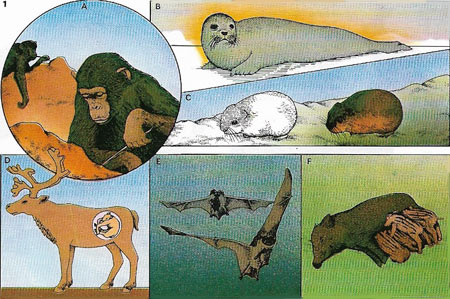
Fig 2. The diversity of mammals is shown in their modes of locomotion, which range from the swimming of seals (B) to the flying of bats (E). They have important features in common. All mammalian young (except for monotremes) spend the first part of their lives inside the mother, who supplies their food and oxygen, for example, the reindeer (D). Young are suckled like those of wild boars (F). A special center in the brain regulates temperature, and usually a fur coat like that of lemmings (C) helps. The brain is highly developed in mammals enabling some, like chimpanzees (A) to use tools.
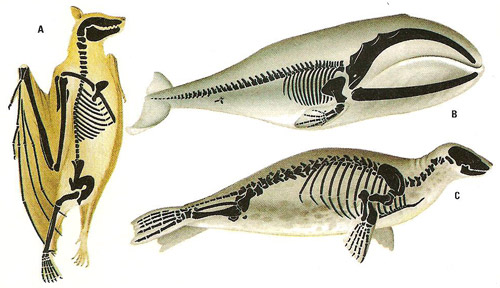
Fig 3. Mammalian skeletons have become modified in many different ways as animals have adapted to different habitats and lifestyles. In primitive mammals, limbs tended to be relatively short, as for instance in the opossum. But adaptations, such as running faster, led to changes, like the elongation of limbs. In bats (A), the forelimbs have become wings, while in seals (B) the limbs form paddle-like flippers. Whales' limbs have a minimal steering function; in baleen whales (C), the jawbones are greatly enlarged and curved to accommodate the animal's huge, sieve-like plates of baleen (whalebone).
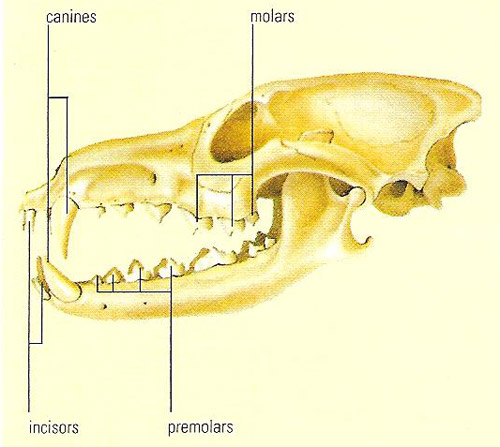
Fig 4. Mammalian specialized teeth.
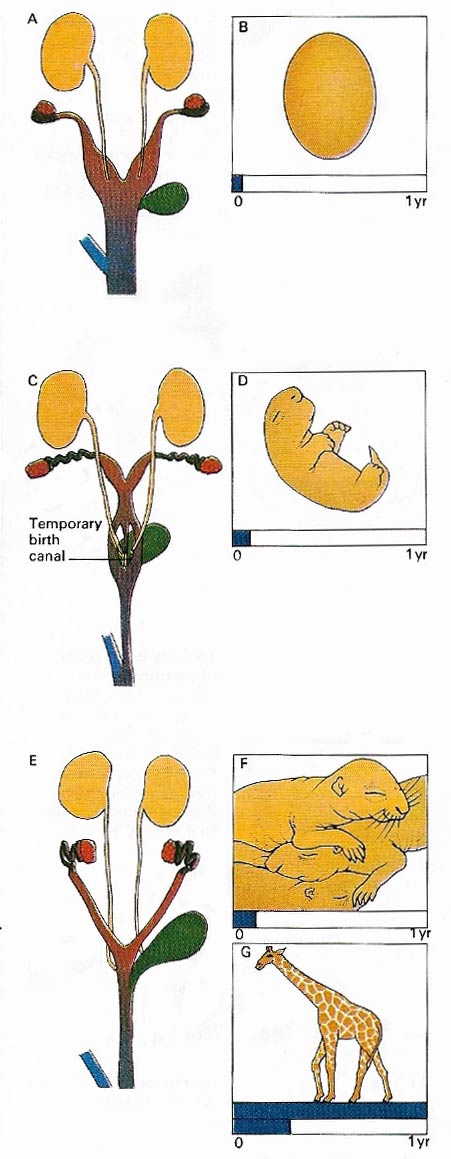
Fig 5. The reproductive arrangements in mammals divide them into three groups (gestation periods in blue). Monotremes, the Protheria have female reproductive systems (A) resembling those of reptiles and produce eggs (B). Thus the development of the young takes place outside the mother's body. Marsupials, the Metatheria, have a two-part vagina (C), but no placenta, and give birth to live young (D) which crawl into the mother's pouch and live there for the remainder of fetal development. Placental animals, the Eutheria (E), have a uterus that can carry the young to an advanced stage of development ranging from the immature rat (F) to the fully formed giraffe (G).
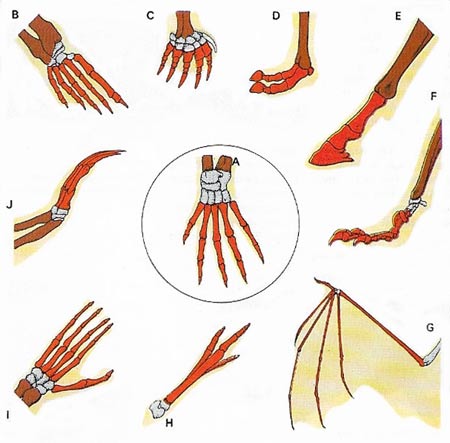
Fig 6. The feet of mammals have evolved in many different ways from the basic mammalian foot A) possessed by the earliest shrew-like mammals. Seals (B) have developed evenly graduated toes for a webbed paddle. Moles (C) have truncated toes for leverage when digging. The camel's two toes (D) are padded for walking on sand. Horses have a hoof (E) instead of claws, and elongated feet for speed, as has the cheetah (F). Bats (G) have enormously elongated digits to support wings. Kangaroo's toes (H) are for hopping. Lemurs (I) and sloths (J) have forelimbs for grasping trees.
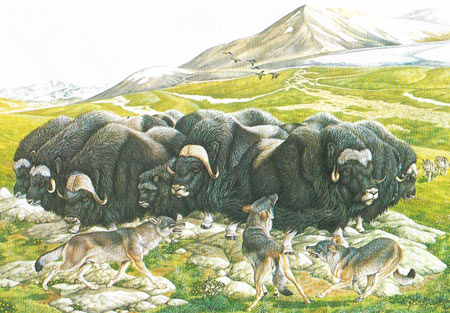
Fig 7. A herd of musk oxen forms a powerful phalanx in a bare landscape to make a defensive ring of bulls around the more vulnerable cows and calves, which are protected in the safety of the center. Living in the harsh Arctic tundra of northern Greenland and Canada the musk ox (Ovibos moschatus) finds natural, predatory enemies in the wolf packs of that inhospitable region. Instead of scattering as the pack attacks the oxen muster together with their great horns pointing outwards. This tactic shows how the basic drive to flee from danger by running away has been superceded by the development of a social instinct requiring communication, coordination, discipline, and courage, in their defensive formation the oxen can defy the wolf pack but if discipline broke down the pack would quickly attack and pull them down.
A mammal is a member of the class Mammalia. Mammals are warm-blooded, usually hairy vertebrates whose offspring are fed with milk secreted by the mammary glands. All but a few are placental (see placenta). More than 5,400 living species are known, including humans and their main domestic animals. The mammals are divided into about 26 orders (a number which varies among authorities) and three subclasses: the Eutheria (placental mammals), the Monotremata (monotremes), and the Metatheria (marsupials). They range in size from shrews weighing a few grams, to the blue whale, which can weigh up to 150 tons.
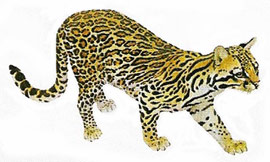 |
| The ocelot of the Americas is a member of the flesh-eating mammal order (Carnivora). It measures from 80 to 142 centimeters (31–58 inches) long and is grouped with all other cats in the family Felidae.
|
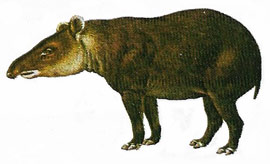 |
| The woolly tapir belongs to the Tapiridae, one of three families in the Perissodactyla, the order of hoofed, odd-toed animals. This tapir is an Andean species an Andean species and grazes on grass and other low-growing vegetation. Like other tapirs it is a docile creature and a good runner, swimmer, and diver. It has similar dimensions to a donkey, measuring 2.5 meters (7.5 feet) long.
|
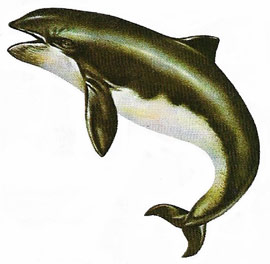 |
| The porpoise is grouped with the whales and dolphins in the order Cetacea. Both porpoises and dolphins are in the family Delphinidae. Porpoises can grow from 1.2 to 1.5 meters (4–5 feet) in length.
|
Evolution of mammals
The mammals probably first evolved about 180 million years ago from a group of warm-blooded reptiles. During the early part of the Eocene period, about 60 million years ago, the mammals found a vast range of habitats available to them due to the extinction of the dinosaurs and evolved along many and varied lines. Several of these early mammal groups became extinct after a few million years and changing conditions left even highly successful orders with only the few representatives that exist today. Thus the elephant, hyrax, and aardvark represent orders (Proboscidea, Hyracoidea, and Tubulidentat, respectively) that have only one modern family remaining. See prehistoric mammals.
General anatomy
In mammals, the bones and muscles of the legs carry the weight of the body, while the backbone is a girder between them from which the gut and other organs hand. The rib-cage protects the lungs and heart, but an important difference between mammals and birds is the separation of these organs from the organs in the lower part of the body by a thin sheet of muscle – the diaphragm.
The brain is more developed in mammals than in any other group, allowing for the variety of activities that is characteristic of them.
Most mammals give birth to their young alive (the monotremes, such as the platypus and spiny anteater, which lay eggs, are an exception); structures occur in the female therefore that are not found in birds and reptiles. In marsupials the young are born at a very early stage and suckled in a pouch. The latter is supported by the so-called epipubic bones. These are not found in other mammals (Fig 5).
Mammalian teeth
Mammalian teeth are usually of several kinds – specialized for grinding, tearing flesh, and so on (Fig 4). Variety is greatest in the carnivores, which have biting incisors, tearing canine teeth, and sharp molars and premolars for crushing bones. Herbivores have more uniform teeth designed for grinding vegetation such as grass.
Temperature control in mammals
Temperature control in mammals is effected largely by means of skin glands and blood vessels located just below the skin. A part of the brain, called the hypothalamus, incorporates a mechanism for detecting changes in blood temperature. If the temperature is too high, activity in the hypothalamus causes the blood vessels of the skin to dilate so that blood heat can be more readily lost and, to encourage this, the sweat glands secrete liquid on to the skin so that it is cooled by evaporation. When the temperature is too low, the skin blood vessels, conversely, are constricted, the sweat glands dry up, and another reflex comes into play to erect the fur (or in the case of humans the meager remnants of it). In a furry animal, the fluffed up hairs make an effective insulating layer. When the skin temperature is uncomfortably low, reflex shivering is induced so that heat is generated by the work of the muscles. Many mammals, especially marine species, have layers of insulating fat beneath their skin.
Within the warm cocoon of its mother's body, the unborn mammal is insulated from the environment for anything from the first few days to the first year or so of its life and most are provided with nourishment by a specially developed organ, the placenta. Nutritional care of the young continues after birth, with suckling.
Diversity and adaptability of mammals
There are herbivores with hoofs, carnivores with claws, omnivores of all kinds; animals that burrow, nest, or build dams; animals with and without teeth, tails, or toes. By strange adaptations of body form, mammals have gained mastery of land, sea, and air.
Some mammals with terrestrial ancestors have evolved to exploit the air and sea. The bats are highly successful, and the only vertebrates other than birds capable of sustained flight. The flying squirrel may prolong what is really no more than a leap by passively holding out sheets of loose skin and gliding. Whales and dolphins have become so well adapted to the marine environment that they never come ashore. The baleen whales have evolved huge filters of baleen (whalebone) with which they sieve the vast shoals of krill that abound in the oceans, particularly in the Antarctic region. Otters, coypus, beavers, and many other carnivores and rodents are proficient swimmers and lead a semi-aquatic life.
In areas scarce of prey, predatory mammals tend to be solitary, like the polar bear, whereas where food is more plentiful, cooperative hunting techniques have evolved, where groups of predators such as hunting dogs or lions cooperate to bring down prey that may be larger than themselves. Many herbivorous mammals have evolved symbiotic relationships with cellulose-digesting bacteria so that they can take advantage of relatively indigestible plant food for which there is less competition. Bears and many primates are omnivorous, feeding on fruits, leaves, and berries, but hunting other creatures when they get the opportunity. Other mammals, such as raccoons and hyenas, are mainly scavengers.
Kangaroos, by the enormous development of the hind limbs, bound over the huge areas of the Australian outback. The fleetest sprinters come from the ungulates, deer and antelopes, and from the carnivores – especially the big cats. Squirrels and primates move along tree branches with ease; the sloth is so completely adapted to an arboreal existence that it is virtually unable to walk on the ground.
Similarities among mammals
Despite geographical isolation, many mammals have adapted in corresponding ways to similar lifestyles in different continents; examples are the anteaters and armadillos of South America, the aardvark of South Africa, the pangolin of Asia, and the echidnas, or spiny-anteaters of Australian and New Guinea – these creatures are all anteaters with long, tough snouts, long tongues, and powerful claws for breaking into nests of ants and termites.
Group survival patterns
Much of the social behavior of mammals is directed towards the survival of the species as a whole. Wolves hunt in packs to enhance their chances of cornering prey and the prey in their turn have developed ways of thwarting bands of predators. In the musk ox this involves the formation of phalanxes, a tactic that is extremely successful.
Co-operation of this sort involves communication between the members of the species, and in mammals this is both widespread and diverse, reaching its most sophisticated level i whales and dolphins and in man and other primates. One of the most familiar nonverbal phenomena is the warning system of rabbits, which thump with their hind feet and flash their white tails as they retreat from danger. Mammalian signals are not just visible and audible: both touch and smell are also important.
The importance of smell
The importance of smell as a stimulus is easy to underestimate from the human point of view, because the sense of smell is relatively poorly developed in man, but is crucial to the behavior of many mammals. Many male mammals are equipped with scent glands that attract females and from the female's smell the male can tell if she is in heat – that is, in the fertile phase of her sexual cycle. Responses to these substances, known as pheromones, can be quite subtle and unexpected. Pregnant female mice, for example, will abort their young if they are put in a cage with a male of another strain. This does not occur if they are put into an empty cage, so the phenomenon has been attributed to a pheromone. Effects of a similar kind may underlie the natural regulation of population density which has been noticed in many colonial species of mammals.
Exclusive bonds between a mother animal and her own young are not always the rule among mammals. Prairie dogs, which are actually large rodents, live in populous colonies that for part of the year are divided into smaller territories containing groups of one or two adult males with females and young. The young are suckled indiscriminately by any female and groomed in a friendly way by any male. The same kind of system is found in small communities of African hunting dogs. Here, however, conflict can arise between females who compete to suckle the young.
The most common source of conflict between mammals is competition for females during the breeding season. This is the underlying reason for the ritual clash of antlers among deer and is one of the defining features of dominance hierarchies in animal groups: the more dominant males have access to larger numbers of females.