Owl Nebula (M97, NGC 3587)
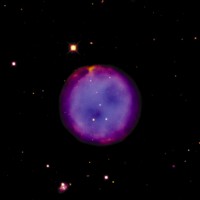
Owl Nebula.
Image: Wendelstein Observatory.
The Owl Nebula (M97, NGC 3587) is a planetary nebula in the constellation Ursa Major. It was the third to be discovered, by Pierre Méchain in 1781, and was named by Lord Rosse in 1848. The Owl is one of the more complex planetary nebulae known. Its appearance has been interpreted as that of a cylindrical torus shell (or globe without poles), viewed obliquely, so that the projected matter-poor ends of the cylinder correspond with the Owl's eyes. This shell is enveloped by a fainter nebula of lower ionization. The mass of the nebula has been estimated at 0.15 solar mass and that of the magnitude 16 central star at 0.7 solar mass.
| visual magnitude | 9.8 |
| angular diameter | 3.4' × 3.3' |
| age | ~6,000 years |
| distance | ~2,600 light-years (790 pc) |
| position | RA 11h 14m 47.7s, Dec +55° 01' 08.5" |
| other designations | PN G148.4+57.0, GCRV 6897, PK 148+57 1, PN ARO 25 |