
pellet stove installation
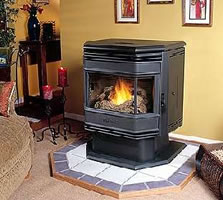
Installing a freestanding pellet stove is much like installing a conventional wood burning stove. By contrast, a pellet stove insert is designed to fit into an existing fireplaces. Whether you intend to do the installation yourself or have a dealer do it, it's vital for both the safety and efficiency of operation that the manufacturer's guidelines be followed.
Placement of a pellet stove
To get the most pleasure and effective heating from your stove, it's usually a good idea to install it in a central living area. It then makes an attractive focal point for the family and the heat it gives out can flow out from this room to other areas of the house. A number of key factors have be considered before installation can get underway.
Floor protection
Unless you already have a suitable hearth in place on which to put your stove, you'll need to have floor protection laid down that meets the manufacturer's specs, including minimum size and type of material. If in doubt get professional advice. Built-in appliances may need extra protection such as an air space between the appliance and the floor protector.
Venting
Find out if this likely to be limited by factors such as obstructions above vertical venting through the ceiling and roof or by the distance to an outside wall for horizontal venting.
Outside air for combustion (if needed)
This has to be drawn from an approved location.
Space requirements
There are minimum specified clearances between the stove and combustibles. But allow more space than the minimum to give enough room to operate and service the stove easily.
Electrical requirements
Because a pellet stove needs electrical power, it has to be located near a properly wired outlet of the correct voltage, ground, and polarity. It's also essential that the circuit to be used has a properly rated circuit breaker.
Venting
Proper venting is vital to for the performance of your stove, safety, keeping maintenance to a minimum, and the quality of the indoor environment. Pellet stoves produce hardly any visible smoke after startup, but exhaust gases, fine ash, and water vapor have to be removed safely from the appliance to the outdoors without leaking into the house. The purpose of all vents is removing combustion by-products during normal operation. For most designs, the exhaust is mechanical: a fan blows the combustion by-products out and draws air needed for combustion into the fire. A few stoves operate without a combustion air fan and use natural draft both for exhaust and combustion air intake. Some heat also moves through the vent. Protection of nearby combustibles is essential. The minimum clearance between the vent and combustibles, as specified in the vent installation instructions, must be met or exceeded to assure safety.
The product specifically tested and listed for use with pellet stoves is PL vent pipe, labeled as tested to UL 641. PL vent pipe is double wall pipe; the stainless steel inner pipe that carries the exhaust products is separated from the outer wall by an air space. Pipe joints must be sealed gas tight to prevent exhaust products moving through the vent under pressure from leaking into the home. Stoves tested and listed requiring PL vent must use no substitute venting materials.
Venting materials and products that MUST NOT BE USED TO VENT PELLET APPLIANCES include:
 |
| Fig. 1 |
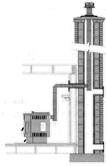
Pellet fireplace inserts and freestanding stoves are often vented into existing masonry and factory-built fireplace and wood stove chimneys (Fig. 1). The chimney should be inspected before installation to ensure that it is clean, mechanically sound, and meets local safety code requirements. The appliance manufacturer's installation instructions may require relining the chimney with an approved metal liner, pipe, or PL vent. Vents or grilles on the face of factory-built fireplaces which provide cooling air to the outside jacket of the fireplace must not be blocked. Clean-out access for future maintenance should be considered.
 |
| Fig. 2 |
 |
| Fig. 3 |
 |
| Fig. 4 |
 |
| Fig. 5 |
 |
| Fig. 6 |
The options for venting layout fall into the following categories:
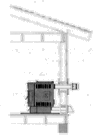
Sidewall horizontal venting(Fig. 2)
Invariably the least expensive venting system. Disadvantage of potential smoke spilling into the house in the event of a power outage or component failure, or house depressurization.
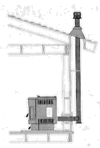
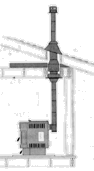
Horizontal vent with backup vertical venting (see Fig. 3)
Preferred horizontal method that avoids venting problems associated with unexpected appliance shutdown.
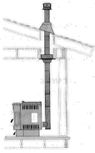
Vertical venting through the ceiling and roof (Fig. 4 and 5)
Has the advantages of keeping vent gases warm and of providing natural draft to prevent problems in an unexpected shutdown.
Venting into existing chimney (see Fig. 1)
Stove manufacturers provide recommendations for venting into masonry and factory-built chimneys, which may include partial or full chimney relining.
Natural Draft
All vents for appliances designed without mechanical exhaust fans must meet stove manufacturer's requirements for minimum draft and must terminate above the roof.
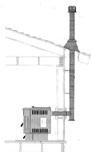
Horizontal and vertical (Fig. 6)
Extends from the top or back of the appliance, penetrates the wall, turns up to penetrate the eave and roof.
Besides appliance requirements, several other factors may be considered in specifying pellet venting systems. The following factors may play a role in the designation of the venting system:
Altitude
High altitude installations, generally higher than 2500 feet above sea level, may require special venting options to provide adequate combustion air and/or draft.
House Pressure
Extremely tight house construction or strong kitchen, bath, or other exhaust fans may create a negative pressure within the home that decreases venting effectiveness. May necessitate an approved outside air source.
Windy Conditions
Unpredictable effects of high winds or prevailing wind conditions may necessitate the addition of vertical venting extending above the roof and/or special termination caps.
Clean-out and Maintenance
The venting system must be designed with normal maintenance in mind.
When assembling and joining together pellet venting components, appliance manufacturer's instructions should be followed closely regarding sealing joints and seams, particularly of pressurized mechanical exhaust vents. It is imperative that they be gas tight so that they cannot leak. Proper application of an approved sealant or sealing band is typically required. Appliance manufacturer's instructions for pipe sealing which exceed vent manufacturer's instructions must take precedence. You can get a sense of what heating with pellets involves through an introduction to the principles of operation and the reasons for maintenance that you will come to understand as an experienced operator.