Pollux (Beta Geminorum)
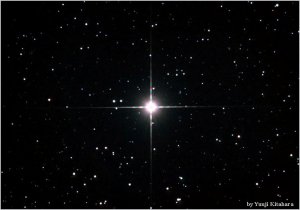
Pollux (Beta Geminorum) is the brightest star in the constellation Gemini (despite its Beta designation), and the 17th brightest in the sky. Pollux is a giant orange K star that makes an interesting color contrast with its white "twin," Castor. Evidence has been found for a a hot, outer, magnetically-supported corona around Pollux, and the star is known to be an X-ray emitter.
| visual magnitude | 1.16 |
| absolute magnitude | 1.08 |
| spectral type | K0IIIb |
| surface temperature | 4,500 K |
| luminosity | 32 Lsun |
| radius | 10 Rsun |
| distance | 34 light-years |
| position | R.A. 07h 45m 18.9s, Dec. +28° 1' 34" |
Discovery of a planet around Pollux
On 16 June 2006, a team of astronomers (including A. P. Hatzes, W. D. Cochran, E. Endl, E. W. Guenther, S. H. Saar, G. A. H. Walker, S. Yang, M. Hartmann, M. Esposito, and D. B. Paulson) confirmed the presence of a Jupiter-class planet around Pollux. Pollux b had been first detected in 1993. Assuming a mass for Pollux of 1.7 solar masses, Pollux b has a minimum mass of 2.3 +/– 0.45 Jupiter-masses. It moves around Pollux at an average distance of 1.64 +/– 0.27 AU in a nearly circular orbit (eccentricity = 0.02 +/– 0.03) with a period of 1.6 years (589.64 +/– 0.81 days).