smell
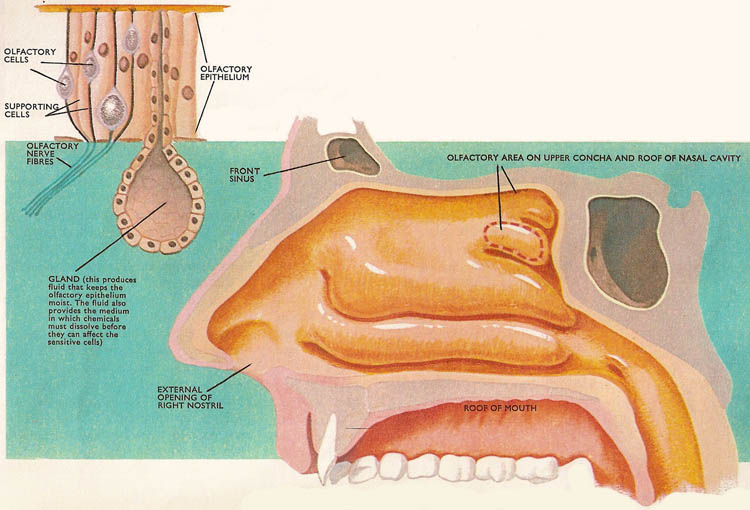
The right half of the nasal cavity viewed from inside showing part of the olfactory are. (Left) A diagram showing the olfactory receptors and their axons and their relationship with the surrounding cells.
Smell is one of the five traditional senses (though
there are others); like the sense of taste it uses receptors called chemoreceptors which are sensitive to chemicals. The smell receptors, together with those
for vision and hearing, form the distance
receptor system. That is, they inform us of conditions at a distance.
The sensitive cells are embedded in the epithelium (lining tissue) of the nose, on the roof of
the nasal cavity, on the upper part of the wall that divides the nose into
two halves, and on the upper fold (concha) in each half.
The olfactory (smell) cells are unique in that their axons pass to the central
nervous system. (Generally, nerve processes grow out from the
central nervous system.) They are surrounded by supporting cells and glands.
The latter produce a yellowish-brown fluid which moistens the ends of the
olfactory cells. The chemicals to which the receptors are sensitive dissolve
in this fluid. Its continuous production washes away chemicals that have
already stimulated the receptors and so leaves them clean and prepared for
further substances. All the olfactory cells have the same structure yet
we can appreciate a wide range of smells. Whereas there are relatively few
taste receptors and few nerve fibers from them, there are many smell receptors
and numerous nerve fibers carrying signals to the brain.
Within the olfactory parts of the brain, which lie in the cerebrum,
the nerve fibers interweave and connect up with others in a complicated
way. Since each part of the olfactory lobe receives impulses from a variety
of receptors because of the elaborate interconnections, a whole range of
different smelling substances can be distinguished.