adrenal gland
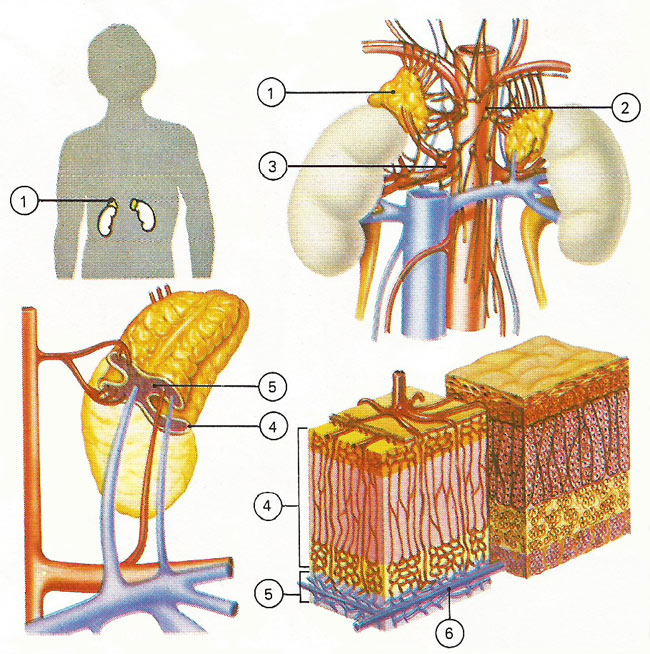
Situated just above the kidneys, the adrenal glands (1) are well supplied with blood entering directly from the aorta (2) and from tributaries of the renal arteries (3). Each gland consists of two separate functional parts: an outer layer or cortex (4) and an inner medulla (5). Only the cortex – secreting steroid hormones to control body chemistry – is essential to life. Taking up raw materials from the arteries, the different cell types of the cortex release their products into the veins (6). The medulla secretes two hormones which prepare the body for action in an emergency.
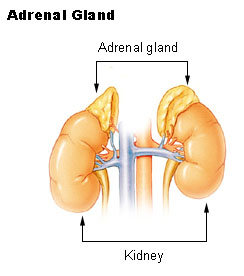
The adrenal gland is an endocrine gland, also called the suprarenal gland, one of which is located near the upper portion of each kidney. Each adrenal gland is divided into an outer part called the cortex and an inner part called the medulla. The cortex and medulla of the adrenal gland, like the anterior and posterior lobes of the pituitary gland, develop from different embryonic tissues and secrete different hormones. The adrenal cortex is essential to life, but the medulla may be removed with no life-threatening effects.
The hypothalamus of the brain influences both portions of the adrenal gland but by different mechanisms. The adrenal cortex is regulated by negative feedback involving the hypothalamus and adrenocorticotropic hormone (ACTH); the medulla is regulated by nerve impulses from the hypothalamus.
Anatomy of the adrenal glands
Both adrenal glands are yellowish in color. The right adrenal gland is pyramidal in shape and caps the upper pole of the right kidney. It lies behind the right lobe of the liver and extends medially behind the inferior vena cava. It rests posteriorly on the diaphragm.
The left adrenal gland is crescent-shaped and extends along the medial border of the left kidney from the upper pole to the hilus. It lies behind the pancreas, the lesser sac, and the stomach, and rests posteriorly on the diaphragm.
Three arteries supply each gland: (1) the suprarenal branch of the inferior phrenic artery, (2) the suprarenal branch of the aorta, and (3) the suprarenal branch of the renal artery. A single vein emerges from the hilus of each gland and drains into the inferior vena cava on the right and into the renal vein on the left. Lymph vessels pass to the lateral aortic nodes.
The nerves are predominantly preganglionic sympathetic fibers and are derived from the splanchnic nerves; the majority of the nerves end in the medulla of the gland.
Hormones of the adrenal cortex
The adrenal cortex consists of three different regions, each of which produces a different group or type of hormones. Chemically, all the cortical hormones are steroids.
Mineralocorticoids are secreted by the outermost region of the adrenal cortex. The principal mineralocorticoid is aldosterone, which acts to conserve sodium ions and water in the body. Glucocorticoids are secreted by the middle region of the adrenal cortex. The principal glucocorticoid is cortisol, which increases blood glucose levels.
The third group of steroids secreted by the adrenal cortex is the gonadocorticoids, or sex hormones. These are secreted by the innermost region. Male hormones (androgens) and female hormones (estrogens) are secreted in minimal amounts in both sexes by the adrenal cortex, but their effect is usually masked by the hormones from the testes and ovaries. In females, the masculinization effect of androgen secretion may become evident after menopause, when estrogen levels from the ovaries decrease.
Aldosterone
Aldosterone is a hormone, of the type known as mineralocorticoids, which is produced by the cortex of the adrenal gland. Aldosterone regulates the concentration of ions in the blood by stimulating the reabsorption of sodium and the excretion of potassium by the kidneys.
Too much aldosterone can cause high blood pressure and a build-up of fluid in body tissues.
Hormones of the adrenal medulla
The adrenal medulla develops from neural tissue and secretes two hormones, adrenaline (epinephrine) and noradrenaline (norepinephrine). These two hormones are secreted in response to stimulation
by sympathetic nerves, particularly during stressful situations. A lack
of hormones from the adrenal medulla produces no significant effects. Hypersecretion,
usually from a tumor, causes prolonged or continual sympathetic responses.