antibiotic
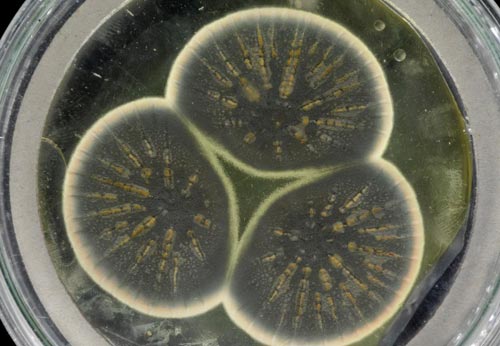
Figure 1. Penicillin mold
An antibiotic is a substance that is capable of stopping the growth of, or
destroying, bacteria and other microorganisms
which cause bacterial disease.
Many antibiotics are themselves produced by microorganisms (bacteria and
molds). Antibiotics are germicides that are safe enough to be swallowed
or injected into the body.
History
Louis Pasteur noted the effect and Alexander Fleming first showed that the mold Penicillium notatum (Figure 1) produced penicillin, a substance able to destroy certain bacteria. It was not until 1940 that Howard Florey and Ernst Chain were able to manufacture sufficient penicillin for clinical use.
The isolation of streptomycin by Albert Schatz (1943), a graduate student in the laboratory of Selman Waksman, of Gramcidin (from tyrothricin) by Dubos, and of the tetracyclines and Cephalosporins, were among early discoveries of antibiotics useful in treating human infection. Semi-synthetic antibiotics, in which the basic molecule is chemically modified, have increased the range of naturally occurring substances. Because some bacteria, once sensitive to certain antibiotics, have now become resistant to them, there is a constant search for new antibiotics.
Action of antibiotics
The introduction of antibiotics, from about the time of World War II, has revolutionized medical science, making possible the virtual elimination of once widespread and often fatal diseases, including typhoid fever, plague, and cholera. Some antibiotics are selective – that is, effective against specific microorganisms; those effective against a large number of microorganisms are known as broad-spectrum antibiotics.
The mode of action of antibiotics ranges from preventing cell-wall synthesis to interference with protein and nucleic acid metabolism. Bacteria resistant to antibiotics either inherently lack susceptibility to their mode of action or have acquired resistance by adaptation (e.g., by learning to make substances which inactivate an antibiotic). Each group of antibiotics has its own particular value and side effect, and antibiotics may induce allergy. Many antibiotics are effective by mouth but injection may e more suitable; topical application can also be used.
Antibiotics do not fight infections caused by viruses,
such as colds, flu,
most coughs and bronchitis,
and sore throats, unless caused by strep.
See also antiseptic.
Antibiotic resistance
Antibiotic resistance is the ability of bacteria or other microbes to resist the effects of an antibiotic. Antibiotic resistance occurs when bacteria change in some way that reduces or eliminates the effectiveness of drugs, chemicals, or other agents designed to cure or prevent infections. The bacteria survive and continue to multiply causing more harm.
Antibiotic resistance has been called one of the world's most pressing public health problems. Almost every type of bacteria has become stronger and less responsive to antibiotic treatment when it is really needed. These antibiotic-resistant bacteria can quickly spread to family members, schoolmates, and co-workers – threatening the community with a new strain of infectious disease that is more difficult to cure and more expensive to treat.
Antibiotic resistance can cause significant danger and suffering for children and adults who have common infections, once easily treatable with antibiotics. Microbes can develop resistance to specific medicines. A common misconception is that a person's body becomes resistant to specific drugs. However, it is microbes, not people, that become resistant to the drugs.
If a microbe is resistant to many drugs, treating the infections it causes can become difficult or even impossible. Someone with an infection that is resistant to a certain medicine can pass that resistant infection to another person. In this way, a hard-to-treat illness can be spread from person to person. In some cases, the illness can lead to serious disability or even death.
Any use of antibiotics, whether appropriate (as in the case of bacterial infections) or not (as in the case of viral infections against which antibiotics are ineffective), promotes the development of antibiotic-resistant bacteria. Every time a person takes antibiotics, sensitive bacteria are killed, but resistant germs may be left to grow and multiply. Repeated and extensive use of antibiotics are the primary causes of the increase in drug-resistant bacteria.
Antibiotic resistance occurs when bacteria change in some way that reduces or eliminates the effectiveness of drugs, chemicals, or other agents designed to cure or prevent infections. The bacteria survive and continue to multiply causing more harm. Bacteria can do this through several mechanisms. Some bacteria develop the ability to neutralize the antibiotic before it can do harm, others can rapidly pump the antibiotic out, and still others can change the antibiotic attack site so it cannot affect the function of the bacteria.
Antibiotics kill or inhibit the growth of susceptible bacteria. Sometimes one of the bacteria survives because it has the ability to neutralize or escape the effect of the antibiotic; that one bacterium can then multiply and replace all the bacteria that were killed off. Exposure to antibiotics therefore provides selective pressure, which makes the surviving bacteria more likely to be resistant. In addition, bacteria that were at one time susceptible to an antibiotic can acquire resistance through mutation of their genetic material or by acquiring pieces of DNA that code for the resistance properties from other bacteria. The DNA that codes for resistance can be grouped in a single easily transferable package. This means that bacteria can become resistant to many antimicrobial agents because of the transfer of one piece of DNA.