bandwidth
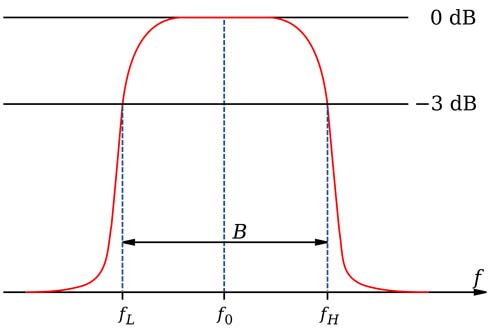
The magnitude response of a band-pass filter illustrating the concept of −3 dB bandwidth at a gain of approximately 0.707.
1. Bandwidth may refer to the range of frequencies that an electronic
signal occupies on a given transmission medium. Any digital or analog
signal has a bandwidth. In digital systems, bandwidth is often expressed
as data speed in bits per second. In analog
systems, bandwidth is expressed in terms of the difference between the
highest-frequency signal component and the lowest-frequency signal component.
For example, a typical voice signal on an analog telephone line has
a bandwidth of about 3 kHz. An analog television (TV) broadcast video
signal has a bandwidth of 6 MHz, some 2,000 times as wide as the telephone
signal. As a general rule, systems with more bandwidth can carry more
information.
2. Bandwidth may also be the range of wavelengths or frequencies to which an antenna is sensitive.
3. In communications and computing, bandwidth is the rate at which data is transferred,
usually measured in bits (or megabits or
gigabits) per second.