chromosome
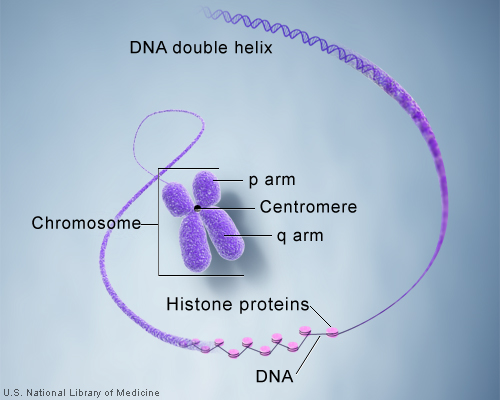
Figure 1. DNA and histone proteins are packaged into structures called chromosomes.
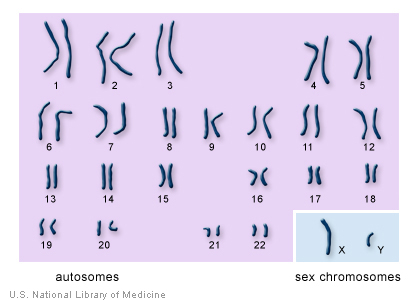
Figure 2. The 22 autosomes are numbered by size. The other two chromosomes, X and Y, are the sex chromosomes. This picture of the human chromosomes lined up in pairs is called a karyotype.
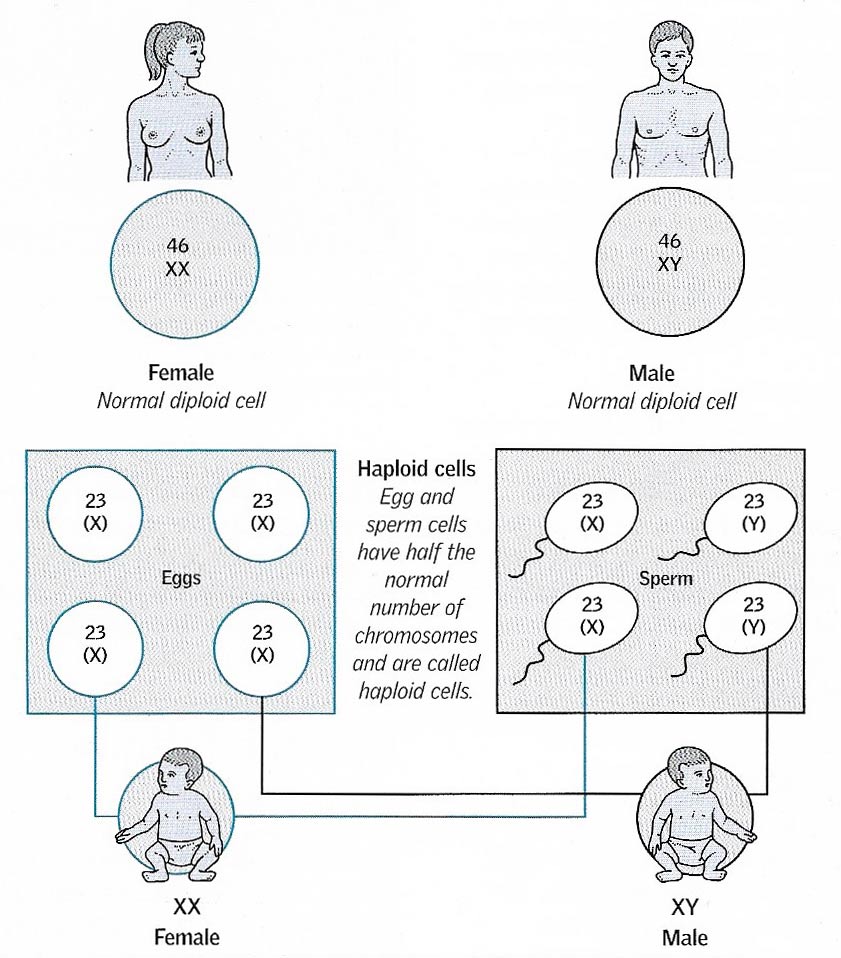
Figure 3. The egg and sperm cells differ from other body cells in that they contain only 23 chromosomes – one from each of the 22 autosome pairs plus an X chromosome (in the case of an egg) and either an X or a Y (in the case of a sperm). Because they have only half the normal complement, they are haploid, while other cells are diploid.
A chromosome is the organelle responsible for the physical transmission of hereditary information (see heredity) from one generation to the next. Among those responsible for establishing the connection between chromosomes and heredity was Calvin Bridges.
In bacteria and archaea, the chromosome consists of a single naked ring of DNA. In eukaryotes, each chromosome consists of a single linear DNA molecule composed of many genes.
Chromosomes are not visible in the cell's nucleus – not even under a microscope – when the cell is not dividing.
However, the DNA that makes up chromosomes becomes more tightly packed during cell division and is then visible
under a microscope. Most of what researchers know about chromosomes was
learned by observing chromosomes during cell division.
Each chromosome has a constriction point called the centromere,
which divides the chromosome into two sections, or "arms." The short arm
of the chromosome is labeled the "p arm." The long arm of the chromosome
is labeled the "q arm." The location of the centromere on each chromosome
gives the chromosome its characteristic shape, and can be used to help describe
the location of specific genes.
Human chromosomes
In humans, each cell normally contains 23 pairs of chromosomes, for a total of 46. Twenty-two of these pairs, called autosomes, look the same in both males and females. The 23rd pair, the sex chromosomes, differ between males and females. Females have two copies of the X chromosome, while males have one X and one Y chromosome.
Homologous chromosome
An homologous chromosome is one of a pair of chromosomes that share the same genetic structure, but not always the same alleles, for a given characteristic. Found in diploid cells, pairs of homologous chromosomes are composed of one chromosome from the female parent, the other from the male. During meiosis, when gametes (sex cells) are formed, homologous chromosomes undergo a complex process known as crossing over, when strands of the chromosomes (chromatids) break from the original chromosome and exchange places with the other member of the pair. The "reshuffling" gives rise to genetic variation, which together with random mutation is an essential part of evolution.
Chromosomal aberration
Chromosomal aberration is any abnormality in the chromosomes of a cell, such as a variation in the normal number or a change in the normal arrangement of the genetic material, which may produce an unexpected characteristic. Down's syndrome, for example, is associated with an extra chromosome. Some malformations have been associated with the absence of sections of certain chromosomes.
Bridges, Calvin Blackman (1889–1938)
Calvin Bridges was an American geneticist who helped prove the chromosomal basis of heredity and sex. His work with Thomas Hunt Morgan on the fruit fly (Drosophila) proved that inheritable variations could be traced to observable changes in the chromosomes. These experiments resulted in the construction of gene maps.