cell division
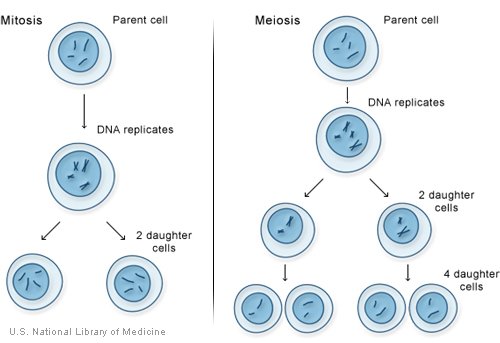
Cell division is the process by which two cells are formed from one. There are two types of cell division: mitosis and meiosis. Most of the time when people refer to "cell division," they mean mitosis, the process of making new body cells. Meiosis is the type of cell division that creates an ovum (egg cell) or sperm cell.
Mitosis is a fundamental process for life. During mitosis, a cell duplicates all of its contents, including its chromosomes, and splits to form two identical daughter cells. Because this process is so critical, the steps of mitosis are carefully controlled by a number of genes. When mitosis is not regulated correctly, health problems such as cancer can result.
The other type of cell division, meiosis, ensures that an organism has the same number of chromosomes in each generation. It is a two-step process that reduces the chromosome number by half – in the case of humans, from 46 to 23 – to form sperm and egg cells. When the sperm and egg cells unite at conception, each contributes 23 chromosomes so the resulting embryo will have the usual 46. Meiosis also allows genetic variation through a process of DNA shuffling while the cells are dividing.
During the brief period of cell division, the DNA in chromosomes becomes highly condensed, making the chromosomes easily visible.