cell
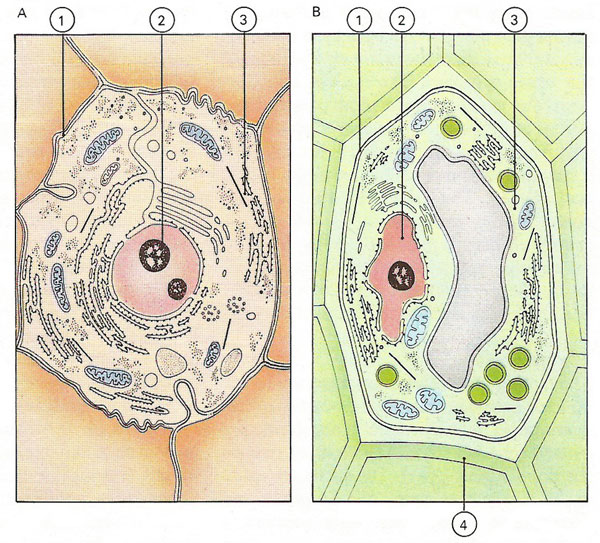
Both animal (A) and plant (B) cells have a cell membrane (1), nucleus (2), and cytoplasm (3). But in plants the cell wall is covered with a rigid coating of cellulose (4).
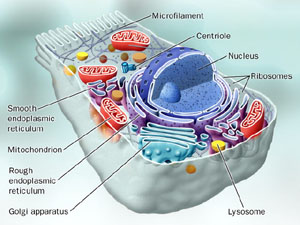
Typical animal cell.
The cell in biology
In biology, the cell is the fundamental unit of terrestrial life. Cells are self-replicating and may exist on their own as independent organisms, as in the case of bacteria, archaea, and protista, or may form colonies or tissues, as in higher life-forms. The two main types of cells are prokaryotic cells and eukaryotic cells.
Each cell consists of protein-rich material that is differentiated into cytoplasm and a nucleus. Forming a boundary around the cytoplasm is a cell membrane, which in plants and some microorganisms is, in turn, surrounded by a cell wall.
Cells were discovered in 1665 by the English scientist Robert Hooke who first observed them through a primitive microscope. Hooke coined the term "cell," in a biological context, when he described the microscopic structure of cork as being like a tiny, bare room or monk's cell. Hooke's investigation led to the development of cell theory, which evolved from the combined efforts of microscopists such as a Dutchman Anton van Leeuwenhoek, who discovered blood cells in 1684. Scottish botanist Robert Brown observed the first nucleus in plant cells i 1833. By 1839, German physiologist Theodor Schwann and German biologist Matthias Schleiden recognized that cells are the elementary particles of organisms in plants and animals, and that some organisms are unicellular and others multicellular. German pathologist Rudolf Virchow confirmed the principle of cell division, essential in growth and reproduction, in 1855.
The cell in mathematics
In mathematics, a cell may refer to either of the following. (i) A three-dimensional object that is part of a higher-dimensional object, such as a polychoron. A cell is related to higher-dimensional objects in the way that a face, or (two-dimensional) polygon, is related to higher-dimensional objects. For example, a cell is to a four-dimensional polytope, or polychoron, what a face is to a 3-dimensional polytope, or polyhedron. Often polytopes are classified simply by how many cells they have. For example, the tesseract has eight cells, each one of which is a cube. (ii) The fundamental spatial unit operated on by the rules of a cellular automaton during one generation.