prokaryotic cell
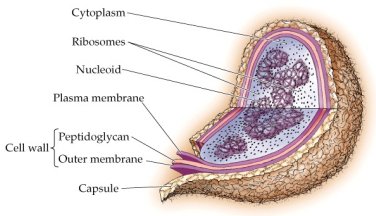
Generalized prokaryotic cell. Image: Sinauer Associates, Inc.
A prokaryotic cell is a cell lacking a membrane-bounded nucleus or membrane-bounded organelles. Prokaryotic cells are thus more primitive than eukaryotic cells, which evolved from them. A prokaryotic organism, such as a bacterium, consists of single prokaryotic cell.
A general prokaryotic cell can be considered to have three architectural regions, though not all the components are always present:
• a cell envelope consisting of a capsule, a cell wall, and a cell membrane
• a cytoplasmic region that contains the cell genome (DNA), ribosomes, and various sorts of inclusions
• appendages, sometimes present, called flagella and pili
In a prokaryotic cell, most of the functions of organelles, such as mitochondria, chloroplasts, and the Golgi apparatus, are taken over by the prokaryotic cell membrane.