
solar cell
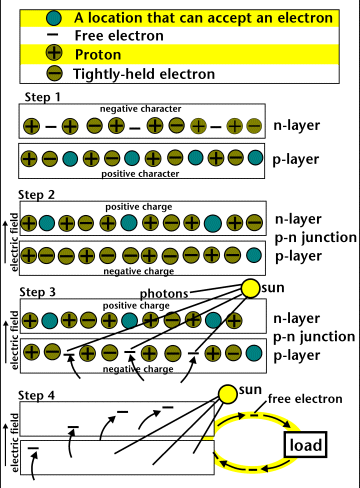
Simplified operation of a solar cell.
Image source: US Dept of Energy.
A solar cell, also called a photovoltaic cell, is used
to convert solar energy into electrical
energy. Solar cells are the basic elements of a solar
module (also known as a solar panel). Silicon is by far the commonest of a variety of semiconductors from which solar cells are made. A typical modern solar cell is square in
shape, measuring 10 centimeters by 10 centimeters. It is covered by a clear anti-reflection
coating (ARC) that reduces the amount of light lost to reflection at
the cell surface.
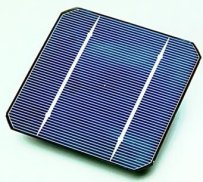 |
| A Siemens solar cell
|
How solar cells work
Like all semiconductor devices, solar cells work with a semiconductor that has been doped to produce two different regions separated by a p-n junction. Across this junction, the two types of charge carrier – electrons and holes – are able to cross. In doing so, they deplete the region from which they came and transfer their charge to the new region. This migration of charge results in a potential gradient or electrical slope, down which charge carriers tend to slide as they approach the junction.
When sunlight strikes a solar cell, atoms are bombarded with particles of light called photons, and give up electrons. When an electron is kicked out of an atom, it leaves behind a hole, which has an equal and opposite (positive) charge. If either carrier wanders across the junction, the field and the nature of the semiconductor material discourage it from recrossing. A proportion of carriers that cross the junction can be harvested by completing a circuit from a grid on the cell's surface to a collector on the backplane. In the cell, the light "pumps" electrons out one side of the cell, through the circuit, and back to the other side, energizing any electrical device that is connected along the way.
The current generated in the semiconductor is extracted by contacts at the top and bottom of the cell. The top contact structure, which must allow light to pass through, is made of thin, widely-spaced metal strips (usually called fingers) that supply current to a larger bus bar. The cell is covered with a thin layer of dielectric material – the anti-reflection coating – to minimize light reflection from the top surface.
Characteristics of a solar cell
The usable voltage that a solar cell produces depends on what semiconductor material it's made from. In the case of silicon-based cells, the output is approximately 0.5 volts (V). Although the current increases with increasing luminosity, the terminal voltage is only weakly dependent on the amount of light falling on the cell. A 100-square-centimeter silicon cell generates a maximum current of about 2 amps when radiated by 1,000 watters per square meter (W/m2.
Different types of solar cell
There are three main types of solar cells, which are distinguished by the type of crystal used in them. They are monocrystalline, polycrystalline, and amorphous. To produce a monocrystalline silicon cell, absolutely pure semiconducting material is necessary. Monocrystalline rods are extracted from melted silicon and then sawed into thin plates. This production process guarantees a relatively high level of efficiency.
| Material | Efficiency in lab (%) | Efficiency of production cell (%) |
| monocrystalline silicon | about 24 | 14-17 |
| polycrystalline silicon | about 18 | 13-15 |
| amorphous silicon | about 13 | 5-7 |
The production of polycrystalline cells is more cost-efficient. In this process, liquid silicon is poured into blocks that are subsequently sawed into plates. During solidification of the material, crystal structures of varying sizes are formed, at whose borders defects emerge. As a result of this crystal defect, the solar cell is less efficient.
If a silicon film is deposited on glass or another substrate material, the result is a so-called amorphous or thin-layer cell. The layer thickness amounts to less than 1μm – the thickness of a human hair for comparison is 50-100 μm. The production costs of this type are lower because of the lower material costs. However, the efficiency of amorphous cells is much lower than that of the other two cell types. As a result, they are used mainly in low power equipment, such as watches and pocket calculators, or as facade elements.
From cells to modules
In order to provide suitable voltages and outputs for different applications, solar cells are connected together to form larger units. Cells connected in series have a higher voltage, while those connected in parallel produce more current. The interconnected solar cells are usually embedded in transparent ethylene vinyl acetate, fitted with an aluminum or stainless steel frame, and covered with transparent glass on the front side to make a solar module.
Typical peak power ratings of such solar modules range from 10 W to 100 W. The characteristic data refer to the standard test conditions of 1000 W/m2 solar radiation at a cell temperature of 25°C (77°F). The manufacturer's standard warranty of 10 or more years is quite long and shows the high quality standards and life expectancy of today's products.